


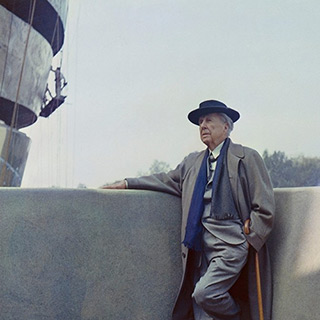


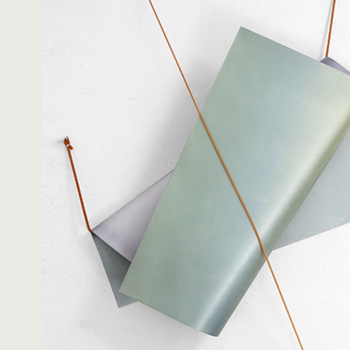



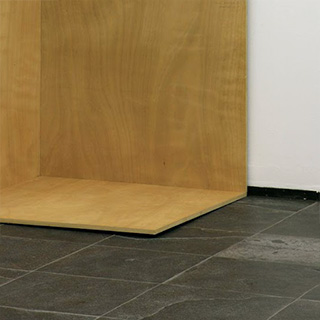


Gary Briechle’s practice is disciplined, almost monastic. Every day roving around Rockland, Maine in an SUV loaded with chemicals, looking at the same mundane scenes and subjects, but expecting different results.

Antoni Tàpies, Recordant, 1999
RELATED ARTICLES

Antoni Tàpies
Artist
Antoni Tàpies (Barcelona, 1923–2012) was a Spanish painter, sculptor and art historian. He was one of the most significant exponents of that Catalan artistic movement most sensitive to the general renewal of the so-called international informal taste. He is considered one of the most important Spanish artists of the twentieth century. Tàpies achieved international recognition by the mid-1950s. In the 1960s, he began incorporating new iconographic elements (writing, signs, anthropomorphic elements, footprints and references to the Catalan situation), and new technical methods (new surfaces, use of everyday objects and varnish). Tàpies’ pictorial language has continued to develop ever since, resulting in a creative and productive body of work that is admired throughout the world.
He has exhibited at the Museum of Modern Art and the Solomon R. Guggenheim Museum, New York; the Museum of Contemporary Art, Los Angeles; the Institute of Contemporary Art and the Serpentine and Hayward Galleries, London; the Neue Nationalgalerie, Berlin; the Kunstahaus, Zurich: the Musée d’Art moderne de la Ville de Paris, the Jeu de Paume and the Centre Pompidou, Paris; the Museo Nacional Centro de Arte Reina Sofía, Madrid; the Institut Valencià d’Art Modern, Valencia; and the Museu d’Art Contemporani de Barcelona, among many other prestigious institutions. The Catalan artist’s work has a study and conservation center at the Fundació Antoni Tàpies in Barcelona.
Antoni Tapies
•
Antoni Tàpies, Recordant, 1999
RELATED ARTICLES
-
Nan GoldinPhotographerNan Goldin is an American photographer known for her deeply personal and candid portraiture. Goldin’s images act as a visual autobiography documenting herself and those closest to her.
-
Jalan & Jibril DurimelPhotographersTwin brothers Jalan & Jibril Durimel draw inspiration through their diversified upbringing between the French Antilles and the US. Born in Paris to parents from the island of Guadeloupe, at the age of 4 they moved to Miami...
-
Mossi Traoré: Fashion, TooMay 20 – Nov 16, 2026After the success of the exhibition “Fashion Folklore”, the Mucem dedicates its 2026 season to Mossi Traoré, a singular voice on the French fashion scene, for whom couture becomes a field of experimentation...
-
Oulu2026: PlayJan 14 – Dec 31, 2026Fotografiska Tallinn brings a photo exhibition to Finland for the first time. Entitled PLAY, the group exhibition is part of the European Capital of Culture programme...
-
Anna Hulačová: AbundantiaOct 1, 2026 – Jan 10, 2027
Anna Hulačová’s figurative sculptures combine influences from Surrealism, Socialist Realism, and Czech folk art to create a distinctive cosmos of their own. Schirn Kunsthalle Frankfurt is presenting the artist’s first solo exhibition in Germany…
-
Artpil / Work OpportunitiesCollaborationsArtpil is seeking to expand the team. From contributors to freelance individuals. Whether you are a writer, photographer, designer, art director, we want to hear from you.
-
The Art of SolitudeMark FearnleyDiscover this fascinating photography book with works by London-based Fine Art Photographer Mark Fearnley. His extraordinary images range from street photography to abstract textures and geometric compositions....
-
Jean-Philippe LebéePhotographerBorn in Northern France, Jean-Philippe Lebée is a photographer and director who is passionate about life and traveling. After his audiovisual and cinema studies, Jean-Philippe Lebée started to study photography at the school Gobelins in Paris.
-
Ahn Chang-Hong: noon-moolSep 5 – Dec 6, 2026American University Museum is honored to present noon-mool, a major solo exhibition by Korean artist Ahn Chang-Hong. Occupying both the second and third floors of the museum, the exhibition offers a rare opportunity...
-
Panorama: Dreams and PlacesFeb 19 – Oct 18, 2026Aiming to present a thematic narrative on contemporary photography and lens-based art in Türkiye, “Panorama: Dreams and Places” brings together a comprehensive selection of works produced since the 2010s by 18 artists from different generations.
-
Argo: Movements of Inner and Outer NatureGwendolyn Hope GussmanArgo is a creative residency program and project space in Athens, Greece. We are open to visual artists, writers, performers, musicians, scholars, and any other creative discipline. Each residency includes accommodation, studio space, research support, and participation in a creative community.
-
The Wild Gene / Ivana FischerSep 18 – Nov 7, 2026“Childhood is a frightening place. Only when considered from a great distance, whether that be across space or time, can it appear carefree and idyllic. Because growing up is always marked by changes that cannot be controlled...
-
Sarah Maple: Double LifeOct 3, 2026 – Apr 4, 2027Museum Arnhem presents Double Life, the first major solo exhibition in the Netherlands by British artist Sarah Maple (b. 1985). In her work, Maple explores what it means when different sides of her identity intersect...
-
Irène ZurkindenAug 27 – Nov 28, 2026Coinciding with Kunsttage Basel, this August we present a solo exhibition dedicated to the work of Swiss artist Irène Zurkinden (1909–1987) at our Basel gallery. Zurkinden defied easy categorisation, developing a distinctive painterly language...
-
Iris van Herpen: Sculpting the SensesMay 16 – Dec 6, 2026
Van Herpen transcends conventional clothing norms while embracing both traditional couture artisanship and innovative techniques. Ranging from the micro to the macro, the exhibition explores the body’s place in space…
-
Extreme PresenceOctober 23–25, 2026What forms does presence take when the world and its technologies exceed what can be explained, known, or felt? How to re-imagine human, non-human and synthetic life on this planet today?
-
Making Futures 2026: International Research ConferenceOctober 29–31, 2026For its 2026 international conference, Making Futures (TM) will explore the relationship between objects, material intelligence and the emotional encounters we design with and through the natural world around us.
SUBMIT YOUR ANNOUNCEMENTS
Visit our New Announcement Submission page > Announcement Submission page >
Visit our New Announcement Submission page > Announcement Submission page >


