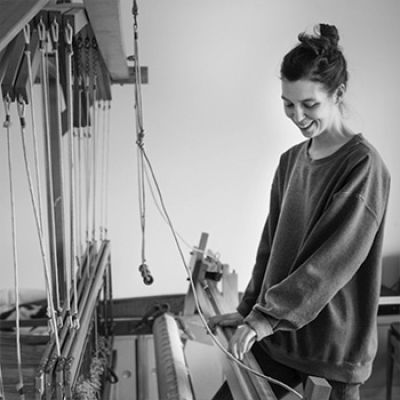
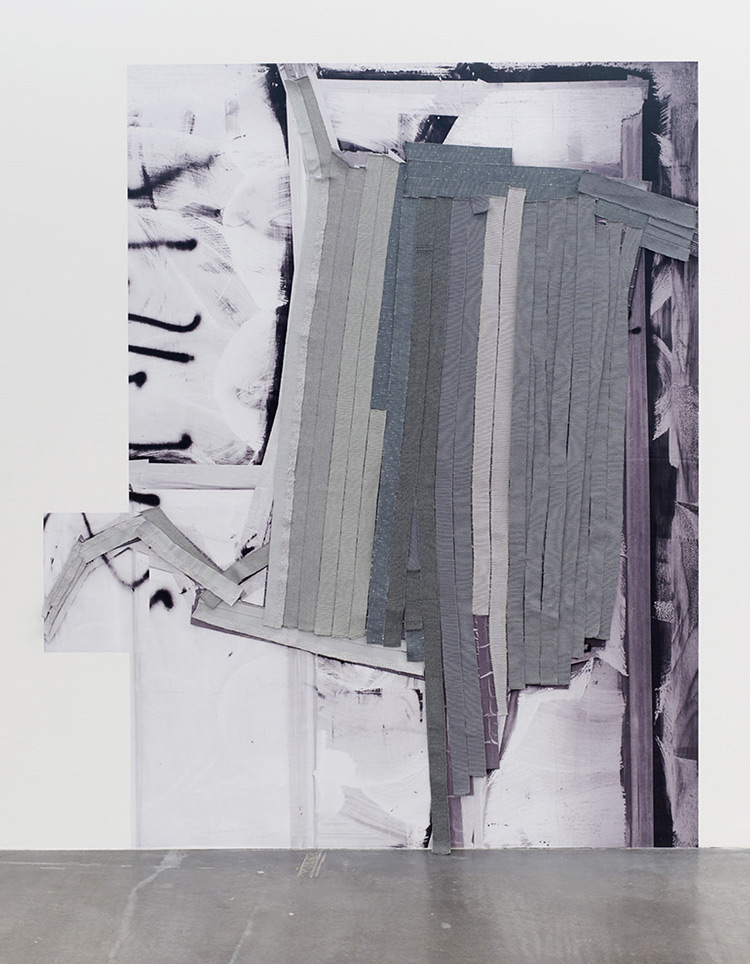
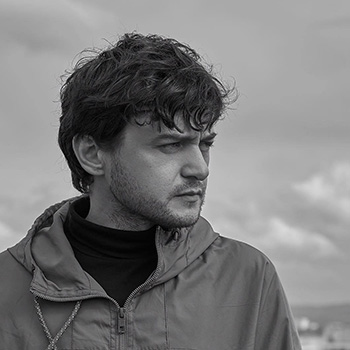
Hana Miletić was born in Zagreb (1982), she lives and works in Brussels and Zagreb. In her work she explores the residues and upheavals of political changes, whereby she focuses on the formation of subjectivity, on the level of both the individual and the community. She describes her artistic practice as street photography via which she documents objects and narratives. Photography serves as a means of orientation in her ongoing exploration of social realities. She has a multiform practice that includes, among others, sculptures, textiles, performances, workshops, printed matter and writing.
The last two years she has developed a weaving practice in community weaving workshops in Brussels. It is a practice that, on the one hand, allows her to connect with a craft rooted in her family’s female genealogy and, on the other hand, provides her with time to engage with its metaphorical social implications. Her cultural roots inform her work, while her research reflects the consequences of political practices and economic influences that reiterate across time and place. Via re-enactment and scrutiny, she addresses inventive approaches to scarcities, damages and obstacles, aiming to bring minor actions and practices to attention and committing to the subversive potential of finding alternative modes of dealing with existing measures, administrations and ideologies.
Hana Miletić was born in Zagreb (1982), she lives and works in Brussels and Zagreb. In her work she explores the residues and upheavals of political changes, whereby she focuses on the formation of subjectivity, on the level of both the individual and the community. She describes her artistic practice as street photography via which she documents objects and narratives. Photography serves as a means of orientation in her ongoing exploration of social realities. She has a multiform practice that includes, among others, sculptures, textiles, performances, workshops, printed matter and writing.
The last two years she has developed a weaving practice in community weaving workshops in Brussels. It is a practice that, on the one hand, allows her to connect with a craft rooted in her family’s female genealogy and, on the other hand, provides her with time to engage with its metaphorical social implications. Her cultural roots inform her work, while her research reflects the consequences of political practices and economic influences that reiterate across time and place. Via re-enactment and scrutiny, she addresses inventive approaches to scarcities, damages and obstacles, aiming to bring minor actions and practices to attention and committing to the subversive potential of finding alternative modes of dealing with existing measures, administrations and ideologies.




-
i-DMagazinei-D has built its reputation on being a consistent source of inspiration in fashion culture. It began as a fanzine dedicated to the street style of punk-era London in 1980, and quickly earned its position at the vanguard of fashion and style, abiding by the premise of originate – don’t imitate.
-
Ukraine, le mal qui reste / Guillaume HerbautOct 8 – Nov 29, 2026From October 8 to November 29, 2026, the Académie des beaux-arts will host the exhibition Ukraine, le mal qui reste (Ukraine, the Evil That Remains) by Guillaume Herbaut, winner of the 2024 Marc Ladreit de Lacharrière...
-
Oulu2026: PlayJan 14 – Dec 31, 2026Fotografiska Tallinn brings a photo exhibition to Finland for the first time. Entitled PLAY, the group exhibition is part of the European Capital of Culture programme...
-
Housekeeping in a Dangerous TimeApr 24 – Dec 31, 2026Housekeeping in a Dangerous Time looks into artistic practices that engage with the contemporary forces shaping intergenerational ties and the distinctions between life stages.
-
A Zona / Diogo SimõesPublication
A Zona is Diogo Simões’s first book. Twelve years in the making, it marks the arrival of a major force in Portuguese photography. All the photos were done in Margem Sul, Tagus river south bank, opposite Lisbon.
-
Foundation Eleutheria Launches During Art Basel ParisInternational cultural initiative
An international cultural initiative connecting contemporary art, cultural heritage, education and sustainability between The Bahamas, Paris and the wider world. Foundation Eleutheria launches…
-
I Want To See A Lighthouseby Gary Briechle
Gary Briechle’s practice is disciplined, almost monastic. Every day roving around Rockland, Maine in an SUV loaded with chemicals, looking at the same mundane scenes and subjects, but expecting different results.
-
Ralph Steadman: And Another ThingAug 26 – Dec 13, 2026Ralph Steadman is one of the most influential British graphic artists of the last 50 years. He is famous for his long collaboration with Hunter S. Thompson, notably illustrating Fear and Loathing in Las Vegas, which inspired two films in 1979 and 1998.
-
Fondazione Arte CRT: The Program2024–2027Since 2000, the Fondazione per l’Arte Moderna e Contemporanea CRT has been building a collection of modern and contemporary art for the benefit of the Piedmont community and its museum network, with acquisitions for GAM – Galleria Civica d’Arte Moderna e Contemporanea di Torino and Castello di Rivoli Museo d’Arte Contemporanea.
-
Marc Chagall: The CircusNov 21, 2026 – Apr 25, 2027
Throughout his prolific career, Marc Chagall (1887–1985) returned time and again to the vivid imagery of acrobats, clowns and fantastical performers. Marc Chagall: The Circus will present Chagall’s celebrated lithographs on this subject…
-
Tina BerningARTIST / ILLUSTRATORTina Berning (b. 1969 / Braunschweig, Germany) is a Berlin based artist and illustrator. After working as a graphic designer for several years, she began to focus on drawing and Illustration.
-
Argo: Movements of Inner and Outer NatureGwendolyn Hope GussmanArgo is a creative residency program and project space in Athens, Greece. We are open to visual artists, writers, performers, musicians, scholars, and any other creative discipline. Each residency includes accommodation, studio space, research support, and participation in a creative community.
-
Ibrahim Mahama: The Time of HarvestsOct 22, 2026 – Feb 28, 2027The Cartier Foundation for Contemporary Art presents The Time of Harvests (Le Temps des récoltes), an exhibition of unprecedented scale in France by Ghanaian artist Ibrahim Mahama, accompanied by nine associated artists...
-
Suki Seokyeong Kang: Mountain – Hour – FaceOct 30, 2026 – Jan 24, 2027Featuring nearly 40 works created between 2014 and 2024, “Suki Seokyeong Kang: Mountain—Hour—Face” is the first solo exhibition by a South Korean artist in the McNay Art Museum’s history.
-
Relic 4: Larry AchiampongOct 16 – Dec 12, 2026This autumn, Larry Achiampong will present his new film Relic 4 (2026) at KARST, revisiting the cinematic universe of the Relic Traveller project after a six-year hiatus. Exploring themes of fallen empire, class, and displacement...
-
Fondation BeyelerMuseum / Riehen, SwitzerlandThe Fondation Beyeler is a museum of modern and contemporary art open 365 days a year. Its exhibitions of renowned artists of the 19th, 20th, and 21st centuries have brought the museum international recognition and established it as Switzerland’s most popular art museum.
-
Arnold J. Kemp: Not One ThingJul 28 – Dec 6, 2026
Arnold J. Kemp: Not One Thing is the first institutional survey of work by the Chicago-based artist Arnold J. Kemp (b. 1968, Boston). The exhibition focuses on Kemp’s performative and material tendencies of masking, traced through various media.
-
Ahn Chang-Hong: noon-moolSep 5 – Dec 6, 2026American University Museum is honored to present noon-mool, a major solo exhibition by Korean artist Ahn Chang-Hong. Occupying both the second and third floors of the museum, the exhibition offers a rare opportunity...
Visit our New Announcement Submission page > Announcement Submission page >