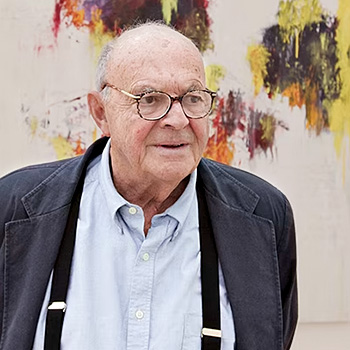
Born in 1973 in Stade, Germany, Iris Schomaker has reached international acclaim through her often large-scale, watercolor paintings of landscapes and figures. What is actually represented in her paintings is secondary to Schomaker’s oeuvre: her work is primarily about the process of representation, about exploring painterly possibilities and the reproduction of atmospheric content. The artist finds her own original visual language in the tension between figurative representation and painterly abstraction.
Schomaker’s palette, mainly applied onto paper, is quiet, and its pastel hues diverge little from black, white, and grey tones. This lends her paintings a drawing-like aspect, which is emphasized still further by the remaining traces of the working process. The searching movements of the lines that document the process of composition appear through the glazed application of paint and fuse with them. Her paintings are just as much about the process of capturing something in a drawing and the discovery of a painterly composition, as they are about the motif itself and its atmospheric and physical qualities.
Iris Schomaker studied Fine Arts in Kiel, Germany, and Trondheim and Bergen, Norway. She has participated in various national exhibitions, including Berlinische Galerie in 2007 and 2010 and in 2013 at Frankfurter Kunstverein. In 2014 she was participant at the biennale in Posnan. Her works can be found in numerous public and private collections.
The artist lives and works in Berlin.
[Galerie Thomas Schulte]




-
Repatriates Collective. Tide of ReturnsMar 28 – Oct 11, 2026Marking the beginning of the 2026 Ocean Space exhibition season, TBA21–Academy presents Tide of Returns, an exhibition running from March 28 until October 11, 2026, based on the artistic-research of the Repatriates Collective
-
Lotta Antonsson: I Am EverythingApr 25 – Nov 29, 2026One of Sweden’s leading contemporary photographers, Lotta Antonsson, is coming to Fotografiska with I Am Everything. In this exhibition, the artist explores themes of gender, identity, and objectification within a visual world
-
Sarah Maple: Double LifeOct 3, 2026 – Apr 4, 2027Museum Arnhem presents Double Life, the first major solo exhibition in the Netherlands by British artist Sarah Maple (b. 1985). In her work, Maple explores what it means when different sides of her identity intersect...
-
World Press Photo 2026Winners & ExhibitionsWorld Press Photo is an independent non-profit organization that champions the power of photojournalism and documentary photography to deepen understanding of the world’s complexities, promote dialogue, and inspire action.
-
Schiaparelli: Fashion Becomes ArtMar 28 – Nov 8, 2026
The UK’s first exhibition on Elsa Schiaparelli spans the 1920s to today, celebrating the innovative designer’s influence. It traces the fashion house’s groundbreaking origins and its evolution under current creative director Daniel Roseberry.
-
Ralph Steadman: And Another ThingAug 26 – Dec 13, 2026Ralph Steadman is one of the most influential British graphic artists of the last 50 years. He is famous for his long collaboration with Hunter S. Thompson, notably illustrating Fear and Loathing in Las Vegas, which inspired two films in 1979 and 1998.
-
Arnold J. Kemp: Not One ThingJul 28 – Dec 6, 2026
Arnold J. Kemp: Not One Thing is the first institutional survey of work by the Chicago-based artist Arnold J. Kemp (b. 1968, Boston). The exhibition focuses on Kemp’s performative and material tendencies of masking, traced through various media.
-
Mossi Traoré: Fashion, TooMay 20 – Nov 16, 2026After the success of the exhibition “Fashion Folklore”, the Mucem dedicates its 2026 season to Mossi Traoré, a singular voice on the French fashion scene, for whom couture becomes a field of experimentation...
-
Sean Scully, 48Apr 18, 2026 – Dec 24, 2028LongHouse welcomes the world-renowned Irish American artist Sean Scully into the garden with his colored stack entitled 48, 2024, a work that epitomizes his deliberate use of stripes and color, with gestures toward land, sea, and sky.
-
Shenzhen Art and Technology BiennaleMay 30, 2026 – Apr 30, 2027The inaugural edition of the Shenzhen Art and Technology Biennale (SATB) opens to the public from May 30, 2026, to April 30, 2027 at Shenzhen International Museum of Art (SIMoA). With its theme A Glimpse of the Infinite, this edition is directed by Zikang Zhang.
-
American Icon: The US Flag in ArtJun 6 – Dec 6, 2026
Across generations, the Stars and Stripes has inspired pride, protest, and profound artistic expression. From battlefields to modern cultural movements, our flag’s journey through art reveals a nation constantly redefining itself.
-
The Present as FoundOctober 2–23, 2026The divergent creative practices of this year’s Zvono Award finalists – Ljiljana Arsić, Isidora Branković, Mustafa Mlinarević, and Emina Veladžić – have shaped a media-heterogeneous, methodologically diverse, and conceptually multilayered exhibition.
-
2027 Brooks International Fellowship ProgrammeDeadline: October 21, 2026
Tate, in collaboration with Delfina Foundation, invites applications for the Brooks International Fellowship Programme 2027. Now in its thirteenth year, the programme will enable practitioners to work with Tate…
-
The Other Side of the MountainOct 14, 2026 – Mar 21, 2027
The Other side of the Mountain brings together contemporary artists working across the African continent and within the Afro-Nordic diaspora. They explore how cities and modern landscapes shape our connections to one another…
-
Lu GuangPhotographerLu Guang was born in 1961, in Zhejiang Province, China. He has been passionate about photography since he held a camera for the first time, in 1980 when he was a factory worker in his hometown in Yongkang County.
-
Ryuichi SakamotoComposer / MusicianIf Ryuichi Sakamoto had been born in 16th century Italy, we’d know what to call him: a Renaissance Man. But since he was born in Japan in the mid-20th century, we have to string together words like composer, musician, producer, actor, and environmental activist.
-
Fondation BeyelerMuseum / Riehen, SwitzerlandThe Fondation Beyeler is a museum of modern and contemporary art open 365 days a year. Its exhibitions of renowned artists of the 19th, 20th, and 21st centuries have brought the museum international recognition and established it as Switzerland’s most popular art museum.
-
Performing Arts Season2026–2027In today’s world, our commitment to connecting community with world-class creative innovators has never been more vital. Vanguard dance, music, and adventurous theater artists offer fresh ideas and energy, while bringing us together...
Visit our New Announcement Submission page > Announcement Submission page >