

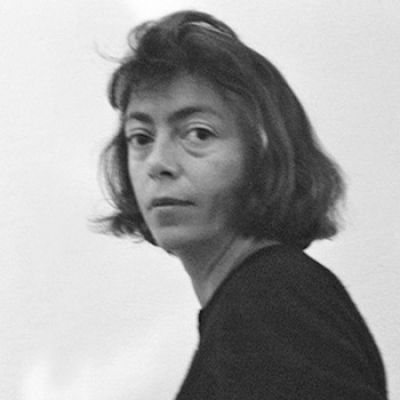
Joan Mitchell was born in Chicago in 1925. After graduating from the School of the Art Institute of Chicago in 1947, she was awarded a James Nelson Raymond Foreign Traveling Fellowship, which took her to France for a year in 1948-49, and it was there that her paintings moved toward abstraction. Returning to New York, she participated in the famous “9th Street Show” in 1951, and soon established a reputation as one of the leading younger American Abstract Expressionist painters. She exhibited regularly in New York throughout the next four decades and maintained close friendships with many New York School painters and poets.
In 1955 she began dividing her time between New York and France, and in 1968 she settled in Vétheuil, a small town in the countryside outside of Paris, where she worked continuously until her death in 1992. During the almost 50 years of her painting life, as Abstract Expressionism was eclipsed by successive styles, Mitchell’s commitment to the tenets of gestural abstraction remained firm and uncompromising. Summing up her achievement, Klaus Kertess wrote, “She transformed the gestural painterliness of Abstract Expressionism into a vocabulary so completely her own that it could become ours as well. And her total absorption of the lessons of Matisse and van Gogh led to a mastery of color inseparable from the movement of light and paint. Her ability to reflect the flow of her consciousness in that of nature, and in paint, is all but unparalleled.”
Mitchell gave personal support to many young artists who came to stay with her at Vétheuil – sometimes for just one night; sometimes for an entire summer. Correspondence in her papers reveals that this generosity often had a life-changing impact on those that spent time with her. Her generosity in her own lifetime continued after her death with the formation of the Joan Mitchell Foundation, called for in her will in order to create support and recognition for individual artists. In addition, the Foundation mission includes the promotion and preservation of her legacy, which includes her remarkable body of work, her papers, including correspondence and photographs, and other archival materials related to her life and work.
Joan Mitchell was born in Chicago in 1925. After graduating from the School of the Art Institute of Chicago in 1947, she was awarded a James Nelson Raymond Foreign Traveling Fellowship, which took her to France for a year in 1948-49, and it was there that her paintings moved toward abstraction. Returning to New York, she participated in the famous “9th Street Show” in 1951, and soon established a reputation as one of the leading younger American Abstract Expressionist painters. She exhibited regularly in New York throughout the next four decades and maintained close friendships with many New York School painters and poets.
In 1955 she began dividing her time between New York and France, and in 1968 she settled in Vétheuil, a small town in the countryside outside of Paris, where she worked continuously until her death in 1992. During the almost 50 years of her painting life, as Abstract Expressionism was eclipsed by successive styles, Mitchell’s commitment to the tenets of gestural abstraction remained firm and uncompromising. Summing up her achievement, Klaus Kertess wrote, “She transformed the gestural painterliness of Abstract Expressionism into a vocabulary so completely her own that it could become ours as well. And her total absorption of the lessons of Matisse and van Gogh led to a mastery of color inseparable from the movement of light and paint. Her ability to reflect the flow of her consciousness in that of nature, and in paint, is all but unparalleled.”
Mitchell gave personal support to many young artists who came to stay with her at Vétheuil – sometimes for just one night; sometimes for an entire summer. Correspondence in her papers reveals that this generosity often had a life-changing impact on those that spent time with her. Her generosity in her own lifetime continued after her death with the formation of the Joan Mitchell Foundation, called for in her will in order to create support and recognition for individual artists. In addition, the Foundation mission includes the promotion and preservation of her legacy, which includes her remarkable body of work, her papers, including correspondence and photographs, and other archival materials related to her life and work.





-
Lundahl & Seitl: The Earths Within UsNovember 2–28, 2026Swedenborg House is pleased to announce The Earths Within Us (2026) by Swedish artist duo Lundahl & Seitl, a limited run of site-sensitive embodied performances at the historic home of the Swedenborg Society throughout November.
-
Fumi Nagasaka: Dora, Yerkwood, Walker County, AlabamaPublicationDuring the 2016 US Presidential elections Japanese photographer, Fumi Nagasaka, became intrigued by the rural and southern USA. She had lived in New York City for a decade but despite travelling the world, had yet to visit the rest of the US.
-
30 Artists Explore Bitcoin, Freedom, and SovereigntyTimechain Art Magazine Ed. 1 / Oct 29 – Nov 19, 2026Timechain Art Magazine presents Edition One, a 154-page fine-art journal featuring 30 artists working across painting, drawing, sculpture, printmaking, and mixed media.
-
Anna Hulačová: AbundantiaOct 1, 2026 – Jan 10, 2027
Anna Hulačová’s figurative sculptures combine influences from Surrealism, Socialist Realism, and Czech folk art to create a distinctive cosmos of their own. Schirn Kunsthalle Frankfurt is presenting the artist’s first solo exhibition in Germany…
-
I Want To See A Lighthouseby Gary Briechle
Gary Briechle’s practice is disciplined, almost monastic. Every day roving around Rockland, Maine in an SUV loaded with chemicals, looking at the same mundane scenes and subjects, but expecting different results.
-
Our 9th Year AnniversaryArtpil / Prescription 176Here we are again, this time, rounding out our ninth year with 7,000 pages of Articles, Profiles, and Announcements in our growing archive and over 10 million visits strong. A very exciting journey it has been ...
-
Chiara Camoni, The Flowers of EvilOct 9, 2026 – Jan 26, 2027
For its second exhibition since the opening of its Roman space, La Società delle Api presents I fiori del male, a project dedicated to the work of Chiara Camoni and curated by Alice Motard…
-
Mark RothkoArtist / PainterMark Rothko was born Marcus Rothkowitz on September 25, 1903, in Dvinsk, Russia. In 1913 his family left Russia and settled in Portland, Oregon. Rothko attended Yale University, New Haven, on a scholarship from 1921 to 1923.
-
Stan Douglas: ParallaxOct 20, 2026 – Jan 10, 2027Jeu de Paume is proud to present Parallax, the largest monographic exhibition devoted to Stan Douglas in France for over thirty years. Born in Vancouver in 1960, this artist, a major figure on the international contemporary art scene...
-
Nadav Kander: The Edge of ThingsSep 18, 2026 – Jan 20, 2027Foam presents The Edge of Things, a major solo exhibition of the internationally renowned artist Nadav Kander. Over more than three decades, Kander has created some of the most celebrated images in contemporary photography...
-
Afterlife Film ProgramSep 5 – Dec 18, 2026Death is one of the few universal experiences of the human condition and, at the same time, one of the most mysterious. Throughout history, religions, spiritual traditions, philosophical schools of thought, and even science have sought to answer the same question...
-
untame flow stay releaseAug 31 – Nov 29, 2026untame flow stay release presents artistic practices undertaken in response to unjust, environmentally toxic and ableist structures – systems that continue to suppress individuals and communities by individualizing violence...
-
Sean Scully, 48Apr 18, 2026 – Dec 24, 2028LongHouse welcomes the world-renowned Irish American artist Sean Scully into the garden with his colored stack entitled 48, 2024, a work that epitomizes his deliberate use of stripes and color, with gestures toward land, sea, and sky.
-
Julie Bullard / Nadia Lee Cohen & Martin ParrPublication
Julie Bullard, a work of photographic fiction by Nadia Lee Cohen and Martin Parr. The book is designed as a late-seventies photo album, closely modelled on an example acquired from eBay, complete with faux leather spongy board covers…
-
Luciano Fabro: Inhabiting SpaceOct 8, 2026 – Feb 21, 2027Pirelli HangarBicocca presents Abitare lo spazio: Inhabiting Space, the first museum retrospective dedicated to Luciano Fabro in Italy since the artist’s death in nearly two decades. The exhibition delves into the concept of “habitat”...
-
David Novros: PaintingOct 9, 2026 – Feb 21, 2027The Hamburger Kunsthalle is devoting a large-scale retrospective to the painter David Novros (b. 1941 in Los Angeles, California), showcasing a fascinating body of work spanning more than six decades.
-
Petra Collins: StarBy Gaelin Rosenwaks
Inspired by 16 years of shooting some of the biggest names in the music world, witnessing the rise and fall of pop icons, and watching descents into madness, Collins created two fictional music groups exclusively for this publication.
-
American Icon: The US Flag in ArtJun 6 – Dec 6, 2026
Across generations, the Stars and Stripes has inspired pride, protest, and profound artistic expression. From battlefields to modern cultural movements, our flag’s journey through art reveals a nation constantly redefining itself.
Visit our New Announcement Submission page > Announcement Submission page >


