


© Lee Miller Archives
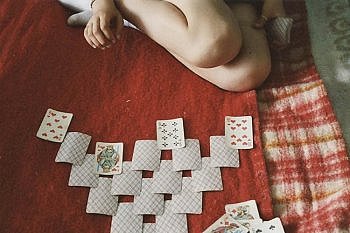


Lee Miller first entered the world of photography as a high fashion model in 1920’s New York. Working with some of the greatest photographers of the day, such as Edward Steichen, George Hoyningen-Huene and Arnold Genthe, Lee’s modelling career was incredibly successful if short-lived. Deciding she would ‘rather take a picture than be one’, in 1929 she moved to Paris to work with the well-known Surrealist artist and photographer Man Ray.
It wasn’t long until Lee established her own photographic studio in the city, working as a commercial portrait and fashion photographer. Lee’s most enduring body of work from this time is her surrealist images of street scenes and studio experimentation, when she re-discovered the Sabattier Effect, a photographic technique later popularised as ‘Solarisation‘, with Man Ray.
Witnessing many of the major events of the Second World War, Lee was billeted in both Hitler and Eva Braun’s houses in Munich, and photographed Hitler’s house, Wachenfeld at Berchtesgaden, in flames on the eve of Germany’s surrender. Penetrating deep into Eastern Europe, she covered harrowing scenes of children dying in Vienna, peasant life in devastated post-war Hungary and finally the execution of Prime Minister Lazlo Bardossy.
Post-war, Lee continued to contribute to Vogue, covering fashion and celebrity culture, including portraits of renowned artists such as Pablo Picasso and Joan Miró. Following the birth of their son, Antony Penrose, Lee and Roland re-located to Farleys, a farm in the East Sussex countryside. There, Lee moved away from professional photography. In the last two decades of her life, she became a celebrated, award-winning cook, known for her dishes inspired by Surrealism. Lee died at Farleys in 1977.
© Lee Miller Archives




-
Calculating Empires / Kate Crawford & Vladan JolerNov 27, 2025 – Jan 31, 2027The monumental installation Calculating Empires impressively demonstrates how power and technology have been intertwined for centuries. The work, by artist-researchers Kate Crawford and Vladan Joler, and has been acquired by Rijksmuseum Twenthe...
-
Todd Hido: #2424-1, 1999 / #3878, 2005from the series Between the TwoPrinted Matter is thrilled to announce the second [#2424-1, 1999] and third [#3878, 2005] in a series of three fundraising Risograph-print editions by the artist Todd Hido. These two images bookend Hido’s most recent Risograph print...
-
Forever Marked By The DayJun 26, 2026 – Jan 3, 2027Reflecting on loss, resilience and the power of rebuilding, “Forever Marked By The Day: A Quarter Century of Mourning and Renewal” marks 25 years since the attacks on Sept. 11, 2001. Approached through an architectural lens, the exhibition fosters intergenerational dialogue...
-
George Watson: The ChoiceJul 4 – Oct 11, 2026In this installation artist George Watson brings together a series of seemingly divergent references – to the farm, the villa, and 19th-century English literature. Recurring elements across the artist’s practice, here they are positioned within a larger narrative...
-
Aesthetica Film Festival 2026November 4–8, 2026Aesthetica Film Festival announces its most expansive programme to date, with York set to become a meeting point for the people shaping the future of film, television, art, sound, games and immersive media this November.
-
Panorama: Dreams and PlacesFeb 19 – Oct 18, 2026Aiming to present a thematic narrative on contemporary photography and lens-based art in Türkiye, “Panorama: Dreams and Places” brings together a comprehensive selection of works produced since the 2010s by 18 artists from different generations.
-
I Want To See A Lighthouseby Gary Briechle
Gary Briechle’s practice is disciplined, almost monastic. Every day roving around Rockland, Maine in an SUV loaded with chemicals, looking at the same mundane scenes and subjects, but expecting different results.
-
On the Peripheryby Sinziana VelicescuSinziana Velicescu’s work is a minimalist and abstract approach, a modern chronicling of a quiet land surveyor, completely separated of sentimentality. The publication of her series is a documentation of time, bracketed in images of framed surfaces of space.
-
2027 Brooks International Fellowship ProgrammeDeadline: October 21, 2026
Tate, in collaboration with Delfina Foundation, invites applications for the Brooks International Fellowship Programme 2027. Now in its thirteenth year, the programme will enable practitioners to work with Tate…
-
Our 9th Year AnniversaryArtpil / Prescription 176Here we are again, this time, rounding out our ninth year with 7,000 pages of Articles, Profiles, and Announcements in our growing archive and over 10 million visits strong. A very exciting journey it has been ...
-
Repatriates Collective. Tide of ReturnsMar 28 – Oct 11, 2026Marking the beginning of the 2026 Ocean Space exhibition season, TBA21–Academy presents Tide of Returns, an exhibition running from March 28 until October 11, 2026, based on the artistic-research of the Repatriates Collective
-
Arthur Boyd: TapestriesJun 18 – Oct, 18, 2026
Boyd commissioned the tapestries, part of his extensive artistic exploration of the life of Saint Francis, from the Manufactura de Tapeçarias de Portalegre, Portugal, and they were purchased by the National Gallery in 1975
-
Irène ZurkindenAug 27 – Nov 28, 2026Coinciding with Kunsttage Basel, this August we present a solo exhibition dedicated to the work of Swiss artist Irène Zurkinden (1909–1987) at our Basel gallery. Zurkinden defied easy categorisation, developing a distinctive painterly language...
-
Sacha TurchiArtistSacha Turchi currently lives and works in Italy and collaborates with various visual and sound artists. The interactions between individual and nature, body and psyche, constitutes the essential matrix of her research.
-
Extreme PresenceOctober 23–25, 2026What forms does presence take when the world and its technologies exceed what can be explained, known, or felt? How to re-imagine human, non-human and synthetic life on this planet today?
-
Lise SarfatiPhotographerBorn in 1958 in Oran, Algeria Lise Sarfati lives and works between Paris and Los Angeles and is represented by Yossi Milo Gallery, NY, Rose Gallery, LA, La Galerie Particulière, Paris.
-
Visionary LandscapesOct 1 – Dec 16, 2026Swedenborg House is pleased to announce Visionary Landscapes, an exhibition exploring the relationship between landscape, imagination and visionary states. Curated by Museum Director Stephen McNeilly, the exhibition brings together historic works in dialogue...
-
Mossi Traoré: Fashion, TooMay 20 – Nov 16, 2026After the success of the exhibition “Fashion Folklore”, the Mucem dedicates its 2026 season to Mossi Traoré, a singular voice on the French fashion scene, for whom couture becomes a field of experimentation...
Visit our New Announcement Submission page > Announcement Submission page >


