


Maria Helena Vieira da Silva was a French-Portuguese painter. Noted for blurring the lines between representation and abstraction, Vieira da Silva’s paintings are produced in a limited palette. Her compositions often consist of checkerboard or grid patterns, layered on top of one another to create spaces reminiscent of interior rooms or aerial city views. Born on June 13, 1908 in Lisbon, Portugal, she moved to France at an early age where she was influenced stylistically and conceptually while studying under artists such as Fernand Léger, Émile Antoine Bourdelle, and Stanley William Hayter. To escape World War II, Vieira da Silva and her husband, the painter Arpad Szenes, fled to Rio de Janeiro, where she lived for seven years. After the war, she returned to Paris, where she remained for the rest of her life and received French citizenship in 1956. Her work, likened to both the mid-century Tachisme and Abstract Expressionism movements, has been critically celebrated throughout the world. The artist was a recipient of a prize at the São Paulo Art Biennial in 1961, and the Árpád Szenes-Vieira da Silva Foundation in Lisbon was built in 1994, a museum that houses a large portion of her works. She died on March 6, 1992 in Paris, France.
[Artnet]

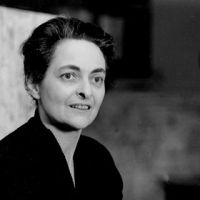
Maria Helena Vieira da Silva was a French-Portuguese painter. Noted for blurring the lines between representation and abstraction, Vieira da Silva’s paintings are produced in a limited palette. Her compositions often consist of checkerboard or grid patterns, layered on top of one another to create spaces reminiscent of interior rooms or aerial city views. Born on June 13, 1908 in Lisbon, Portugal, she moved to France at an early age where she was influenced stylistically and conceptually while studying under artists such as Fernand Léger, Émile Antoine Bourdelle, and Stanley William Hayter. To escape World War II, Vieira da Silva and her husband, the painter Arpad Szenes, fled to Rio de Janeiro, where she lived for seven years. After the war, she returned to Paris, where she remained for the rest of her life and received French citizenship in 1956. Her work, likened to both the mid-century Tachisme and Abstract Expressionism movements, has been critically celebrated throughout the world. The artist was a recipient of a prize at the São Paulo Art Biennial in 1961, and the Árpád Szenes-Vieira da Silva Foundation in Lisbon was built in 1994, a museum that houses a large portion of her works. She died on March 6, 1992 in Paris, France.
[Artnet]







-
Solidarity in Flux / Cross-Baltic collaborationNovember 20, 2026Solidarity in Flux is a cross-Baltic collaboration exploring contemporary manifestations of solidarity in the artistic and cultural narratives of the Baltic region and beyond. Taking place during the closing days of Biennale Arte 2026...
-
Alen MacWeeney: ANTHOLOGYDec 5, 2026 – Feb 7, 2027Photo Museum Ireland presents Alen MacWeeney: ANTHOLOGY, the landmark retrospective exhibition, and stunning new monograph by one of Ireland’s most significant photographers.
-
Ulrich Seidl: On Life, Love, and DeathSep 19, 2026 – Jan 31, 2027Eye Filmmuseum presents Ulrich Seidl – Über das Leben, die Liebe und den Tod, the first exhibition – and the first complete film overview – of the renowned Austrian filmmaker in the Netherlands.
-
Afterlife Film ProgramSep 5 – Dec 18, 2026Death is one of the few universal experiences of the human condition and, at the same time, one of the most mysterious. Throughout history, religions, spiritual traditions, philosophical schools of thought, and even science have sought to answer the same question...
-
Petra Collins: StarBy Gaelin Rosenwaks
Inspired by 16 years of shooting some of the biggest names in the music world, witnessing the rise and fall of pop icons, and watching descents into madness, Collins created two fictional music groups exclusively for this publication.
-
The Other Side of the MountainOct 14, 2026 – Mar 21, 2027
The Other side of the Mountain brings together contemporary artists working across the African continent and within the Afro-Nordic diaspora. They explore how cities and modern landscapes shape our connections to one another…
-
Ryuichi SakamotoComposer / MusicianIf Ryuichi Sakamoto had been born in 16th century Italy, we’d know what to call him: a Renaissance Man. But since he was born in Japan in the mid-20th century, we have to string together words like composer, musician, producer, actor, and environmental activist.
-
untame flow stay releaseAug 31 – Nov 29, 2026untame flow stay release presents artistic practices undertaken in response to unjust, environmentally toxic and ableist structures – systems that continue to suppress individuals and communities by individualizing violence...
-
Jasper JohnsArtistJasper Johns was an artist that came onto the scene in the 1950s. Much of the work that he created led the American public away from the expressionism form, and towards an art movement or form known as the concrete.
-
Nadav Kander: The Edge of ThingsSep 18, 2026 – Jan 20, 2027Foam presents The Edge of Things, a major solo exhibition of the internationally renowned artist Nadav Kander. Over more than three decades, Kander has created some of the most celebrated images in contemporary photography...
-
Performing Arts Season2026–2027In today’s world, our commitment to connecting community with world-class creative innovators has never been more vital. Vanguard dance, music, and adventurous theater artists offer fresh ideas and energy, while bringing us together...
-
Relic 4: Larry AchiampongOct 16 – Dec 12, 2026This autumn, Larry Achiampong will present his new film Relic 4 (2026) at KARST, revisiting the cinematic universe of the Relic Traveller project after a six-year hiatus. Exploring themes of fallen empire, class, and displacement...
-
Visionary LandscapesOct 1 – Dec 16, 2026Swedenborg House is pleased to announce Visionary Landscapes, an exhibition exploring the relationship between landscape, imagination and visionary states. Curated by Museum Director Stephen McNeilly, the exhibition brings together historic works in dialogue...
-
i-DMagazinei-D has built its reputation on being a consistent source of inspiration in fashion culture. It began as a fanzine dedicated to the street style of punk-era London in 1980, and quickly earned its position at the vanguard of fashion and style, abiding by the premise of originate – don’t imitate.
-
Ordinary GriefA Story of ReconciliationOrdinary Grief is a story of tenuous reconciliation. In 2017, I returned to Iran after 25 years of self-exile, where I embarked on a personal and political reclamation of my identity and history.
-
40th Anniversary Archival PresentationMar 19 – Dec 20, 2026The MIT List Visual Arts Center traces its origins to the Hayden Gallery (founded in 1950), which brought artists and the MIT community together through diverse exhibitions and residency projects.
-
The Art of SolitudeMark FearnleyDiscover this fascinating photography book with works by London-based Fine Art Photographer Mark Fearnley. His extraordinary images range from street photography to abstract textures and geometric compositions....
-
Imagining an ArchipelagoJul 11, 2026 – Jun 6, 2027Art connects islands across thousands of miles in “Imagining an Archipelago: Art from Cuba, Guam, the Philippines, Puerto Rico, and Their Diasporas.” The visually stunning exhibition brings together more than 40 contemporary artists...
Visit our New Announcement Submission page > Announcement Submission page >


