RELATED ARTICLES


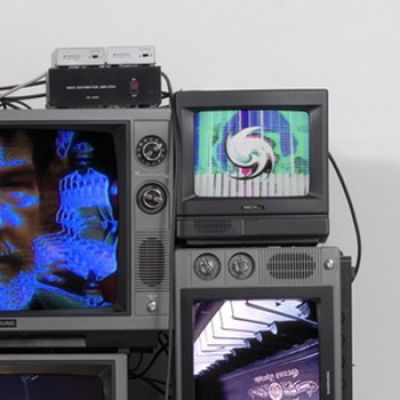
Nam June Paik
Video Artist
Nam June Paik is considered to be one of the founders of video art. After studying art history and music in Tokyo, he moved to Germany in 1956. There, he got to know Karlheinz Stockhausen, who introduced him to electroacoustic music and the work of John Cage. In 1960 Paik joined the Fluxus movement and performed many pieces based on the deconstruction of sound forms. At the same time he was making his first works incorporating television. These generally examined the possibilities of manipulating and coloring images through sound or by disturbing the cathode ray tube. Using multiple images, collage, inlay and layering in a random manner, he created video sculptures, sometimes anthropomorphic, in which images flash by rapidly on a stack of monitors. Greatly ahead of his time, in 1974 he invented forms of mixing and sampling, and in 1984 he anticipated the planetary dimension of art through his interest in satellite communication.
Nam June Paik
Video Artist
Nam June Paik is considered to be one of the founders of video art. After studying art history and music in Tokyo, he moved to Germany in 1956. There, he got to know Karlheinz Stockhausen, who introduced him to electroacoustic music and the work of John Cage. In 1960 Paik joined the Fluxus movement and performed many pieces based on the deconstruction of sound forms. At the same time he was making his first works incorporating television. These generally examined the possibilities of manipulating and coloring images through sound or by disturbing the cathode ray tube. Using multiple images, collage, inlay and layering in a random manner, he created video sculptures, sometimes anthropomorphic, in which images flash by rapidly on a stack of monitors. Greatly ahead of his time, in 1974 he invented forms of mixing and sampling, and in 1984 he anticipated the planetary dimension of art through his interest in satellite communication.
•
RELATED ARTICLES


-
Tiffany Sia: Overt ListeningNov 13, 2026 – Jan 24, 2027Kunsthalle Wien presents the first institutional solo exhibition in Austria by Tiffany Sia (b. 1988, Hong Kong). Overt Listening is centred around a new film which takes as its subject the Kinmen Islands in Taiwan, just a few kilometres off the Chinese coast.
-
The Other Side of the MountainOct 14, 2026 – Mar 21, 2027
The Other side of the Mountain brings together contemporary artists working across the African continent and within the Afro-Nordic diaspora. They explore how cities and modern landscapes shape our connections to one another…
-
Arnold J. Kemp: Not One ThingJul 28 – Dec 6, 2026
Arnold J. Kemp: Not One Thing is the first institutional survey of work by the Chicago-based artist Arnold J. Kemp (b. 1968, Boston). The exhibition focuses on Kemp’s performative and material tendencies of masking, traced through various media.
-
Irène ZurkindenAug 27 – Dec 19, 2026Coinciding with Kunsttage Basel, this August we present a solo exhibition dedicated to the work of Swiss artist Irène Zurkinden (1909–1987) at our Basel gallery. Zurkinden defied easy categorisation, developing a distinctive painterly language...
-
American Icon: The US Flag in ArtJun 6 – Dec 6, 2026
Across generations, the Stars and Stripes has inspired pride, protest, and profound artistic expression. From battlefields to modern cultural movements, our flag’s journey through art reveals a nation constantly redefining itself.
-
The Art of SolitudeMark FearnleyDiscover this fascinating photography book with works by London-based Fine Art Photographer Mark Fearnley. His extraordinary images range from street photography to abstract textures and geometric compositions....
-
Performing Arts Season2026–2027In today’s world, our commitment to connecting community with world-class creative innovators has never been more vital. Vanguard dance, music, and adventurous theater artists offer fresh ideas and energy, while bringing us together...
-
Calculating Empires / Kate Crawford & Vladan JolerNov 27, 2025 – Jan 31, 2027The monumental installation Calculating Empires impressively demonstrates how power and technology have been intertwined for centuries. The work, by artist-researchers Kate Crawford and Vladan Joler, and has been acquired by Rijksmuseum Twenthe...
-
Marc Chagall: The CircusNov 21, 2026 – Apr 25, 2027
Throughout his prolific career, Marc Chagall (1887–1985) returned time and again to the vivid imagery of acrobats, clowns and fantastical performers. Marc Chagall: The Circus will present Chagall’s celebrated lithographs on this subject…
-
Marc LagrangePhotographerMarc Lagrange (1957–2015) was born in Kinshasa, Congo. His career path led him from engineering to photography, and his creativity from fashion to art. Privileging analog over digital, the Antwerp-based Belgian artist searched for intimacy and emotion as opposed to artificial effects.
-
Saatchi GalleryLondonThe Saatchi Gallery aims to provide an innovative forum for contemporary art, presenting work by largely unseen young artists or by international artists whose work has been rarely or never exhibited in the UK.
-
In The Next Door Room / Lise SarfatiPhotography of Lise SarfatiThe awakening of adolescence has been a recurring theme that has always fascinated a great many visual artists; conflicts of identity, physical metamorphosis, psychological instability, emerging sexual and emotional sensations within young people...
-
Orgasmagoria by Dries VerhoevenNov 28, 2026 – Mar 6, 2027Starting November 28, Brutus Art Space will present Orgasmagoria (2026), an ongoing film by artist Dries Verhoeven about sexual gratification in the digital age. The work will premiere in November at the International Documentary Film Festival Amsterdam (IDFA).
-
Lotta Antonsson: I Am EverythingApr 25 – Nov 29, 2026One of Sweden’s leading contemporary photographers, Lotta Antonsson, is coming to Fotografiska with I Am Everything. In this exhibition, the artist explores themes of gender, identity, and objectification within a visual world
-
The Sacred Mountain / Jinjoon LeeOct 24 – Dec 19, 2026Opening at Gallery VER, Bangkok, on 24 October 2026 to mark the gallery’s 20th anniversary, Jinjoon Lee’s solo exhibition The Sacred Mountain asks what we hold sacred, and how we might sustain our relationship with nature and with machines...
-
Sarah Maple: Double LifeOct 3, 2026 – Apr 4, 2027Museum Arnhem presents Double Life, the first major solo exhibition in the Netherlands by British artist Sarah Maple (b. 1985). In her work, Maple explores what it means when different sides of her identity intersect...
-
39th Panorama of Brazilian ArtSep 12, 2026 – Jan 24, 2027Entitled After It’s All Said, 39th Panorama of Brazilian Art, under the curatorship of Diane Lima, questions where artistic production has overflowed in the search to expand the limits of aesthetic representation through a radical exercise of imagination.
-
Our 9th Year AnniversaryArtpil / Prescription 176Here we are again, this time, rounding out our ninth year with 7,000 pages of Articles, Profiles, and Announcements in our growing archive and over 10 million visits strong. A very exciting journey it has been ...
SUBMIT YOUR ANNOUNCEMENTS
Visit our New Announcement Submission page > Announcement Submission page >
Visit our New Announcement Submission page > Announcement Submission page >