Let’s Go Back Home, 2026, Twelve-hour walking performance, Kubuqi Desert, China. Detail / Lihong Bai
To think of nomadism as a condition of precarity is no longer contemporary. The themes of migration, diaspora, statelessness, and everything encompassed in “leaving behind” in order to “move toward” belong to a flow of displacement that contributes to building a shared, interstitial culture. A reflection on environmental conditions is equally necessary, as is a critical analysis of social conditions, the possibilities of choice that impact quality of life, the sense of frustration in imagining a milder elsewhere, a second New World. Thinking about mobility, and about being mobile not by vocation but by necessity, clearly concerns displacement itself, but often fails to consider the baggage being carried, what is left behind, the unforeseen shock of encountering difference.
Lihong Bai (1999, Ordos, Inner Mongolia, China) articulates a set of reflections on contemporaneity through an artistic practice that unfolds into a new body of work after fifteen years of traditional painting. The concept of Shanshui (literally, Mountain-Water), typical of Chinese landscape painting, is revolutionized in the artist’s vision, subverting the stability of the traditional human–nature–landscape conception. Landscape is thus rethought as a mutable condition made of borders, infrastructures, migration, institutions, and environmental resources: a landscape that is not a pre-given background, but a mobile environment.

Let’s Go Back Home, 2026, Twelve-hour walking performance, Kubuqi Desert, China. Detail / Lihong Bai

Outsider, 2026, Installation view / Lihong Bai

Let’s Go Back Home, 2026, Twelve-hour walking performance, Kubuqi Desert, China. Wide view / Jinhu Xue
Movement, displacement, migration, flux: these are all terms that performance art draws on within contemporary art capable of serving as both the field of application and the field of expression for mutability and mobility, it expands and contracts to gather within itself a multitude of meanings, themselves nourished by a shifting, multidirectional surrounding environment. As a series of trajectories intersect at a single point while retaining their future direction and their traced path, the body becomes the material of accumulation, a living archive in perpetual transformation.
Building on this reflection, the artist Lihong Bai can be considered a concrete example of the concepts of mobility and transmediality. Favoring performance as her mode of expression, the body is used as a possibilist instrument, forced into nomadism by geographic conditions. According to a structuralist anthropological view, when territorial resources are scarce, the human being becomes mobile and nomadic, and the search for conditions favorable to life ceases to be a choice. Having grown up in Inner Mongolia, Bai’s nomadism is far removed from the romantic narrative of travel understood in a capitalist sense. The dizzying experience of ceaseless, indiscriminate tourism has nothing to do with her practice. Hers is instead an example of a form of survival under shifting conditions, observed and enacted through a Westernized lens shaped during her time in London, where she completed her studies at the Royal College of Art, within a continuous practice she has actively pursued since the age of six.

Guest, 2026, Single-channel video, 4-minute loop. A living sheep positioned before a government building in Inner Mongolia, China / Lihong Bai

I Have a Goat Joint Bone, 2022, Single-channel video, 12-minute loop. Filmed in Ulanqab, Inner Mongolia, China / Lihong Bai

I Have a Goat Joint Bone, 2022, Single-channel video, 12-minute loop. Filmed in Ulanqab, Inner Mongolia, China / Lihong Bai

Guest, 2026, Single-channel video, 4-minute loop. A living sheep positioned before a government building in Inner Mongolia, China. Wide view / Ziqi (Tree) Xu
Mobility is also acquired and expressed through the breaking down of distinctions between artistic practices, which lends her work both expressive suppleness and conceptual depth. But it is not resolved in this alone: Bai transforms the body into an active instrument for shifting attention away from the everyday, creating moments of tension and cognitive paradox, all the more powerful for being inserted into contexts where custom and habit are dominant, and are themselves dominated by the sequences of habit. The body functions simultaneously as material, witness and site, gathering into itself, as an associated individual, a condition of perpetual compromise between an established social structure and a possible one.
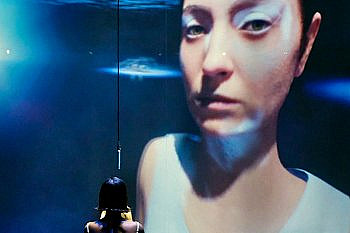
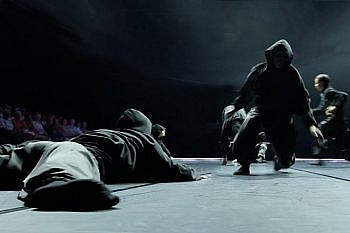
This theme takes shape in OUTSIDER, the final result of a multidisciplinary research project carried out between Mongolia and England. The project’s aims encompass the theme of mobility as nomadism, the sense of belonging, a critique of institutions, the theme of mirrored gesture, of proximal relativity, of shared meanings and social customs. In a participatory performance that proposes a geographic and temporal diversification, Bai gathers and records a series of actions: pushing a taxidermied sheep across the Kubuqi desert for twelve hours (Let’s Go Back Home, 2026); placing a live sheep in front of a government institutional building (Guest, 2026); eating field grass while dressed in evening wear, seated on the London Underground (Passenger, 2026). All actions that resolve into the conceptual syntax of the performance staged at the Handbag Factory in London in 2026. The complexity of nomadism is here entrusted to just four elements: a table resembling a mortuary slab, a swinging lamp, the body reacting to light, and shared space. Around them, the nomadic diary recounts its origins and seems to set off again within the gap of understanding that Bai intends to provoke in “foreign land.”

Passenger, 2026, Single-channel video, 10-minute loop. London Underground / Ziqi (Tree) Xu

Passenger, 2026, Single-channel video, 10-minute loop. London Underground / Zhicong Chen

Passenger, 2026, Single-channel video, 10-minute loop. London Underground / Ciprian Ivanov

Transit, 2026, Single-channel video, 10-minute loop, with field recordings from Embankment Station, London / Ziqi (Tree) Xu

Transit, 2026, Single-channel video, 10-minute loop, with field recordings from Embankment Station, London / Ciprian Ivanov
In her broader research, projects such as Compendium of Materia Medica (Inner Mongolia Desert, 2023) and I Have a Goat Joint Bone (Uxin Banner, Inner Mongolia, 2022) look to childhood as a temporality made of a human–nature relationship that consumes itself in its own becoming.
In Let’s Go Back Home (2026), Bai crosses the Kubuqi desert for twelve hours, pushing a taxidermied sheep. The gesture is simple and unrelenting. The Kubuqi (historically among the most aggressive deserts in northern China) is today also the most frequently cited symbol of state-led environmental regeneration, a reforested landscape presented to the world as an ecological victory. Bai thus crosses a double landscape: the real one, and the narrated one, which power recounts as already resolved. The taxidermied sheep, a dead, embalmed animal rather than a living one, as in Guest, turns the performance into a mobile funeral: what is being carried home is not an animal, but the remainder of a relationship between human, nature and landscape that traditional nomadism made possible for centuries, and that desertification, even before modernization, had already interrupted. Bai’s body, in this crossing, is at once a subject in motion and a device that measures geographic, temporal, and political distance toward a condition of belonging and reappropriation.

Outsider, 2026, Documentation of a 30-minute live performance at Handbag Factory, London / Ziqi (Tree) Xu

Outsider, 2026, Documentation of a 30-minute live performance at Handbag Factory, London / Ziqi (Tree) Xu
The concern for a desertifying landscape (according to the 2026 National Desertification Atlas, 81.9% of Mongolia’s territory is now affected by desertification and soil degradation, five percentage points higher than in 2020), for the disappearance of ancient traditional practices such as the use of medicinal herbs, animal sacrifice, and the interpenetration of human being and landscape, and for the awareness of a fragile, inevitable gap between memory and learning, take shape in these projects as funerary symbols, as combustion, as pulverization in the return to the earth of a material and conceptual ash that becomes part of the larger environment to which it belongs. To burn medicinal herbs is to burn the memory of millennia-old traditions (Compendium of Materia Medica); just as collecting the remains of animals offered in sacrifice according to ancient customs is a reflection on death as a circular process. Bai lends symbolism and the dignity of memory to her personal archive of experience, bringing to her work a ruthless environmentalist critique, a sensitive gaze turned toward the self, and a destabilizing provocation aimed at established, immobile, stagnant social structures.
For Bai, urbanization, desertification, metamorphosis, travel, and reciprocity are not merely political questions, but experiential actions that move with her, radiating outward from wherever she happens to be, across past, future, personal and collective time, within an artistic language that detaches itself from the technical sense of “practice” and finally becomes experiential act and lived experience within the contemporary.
Lihong Bai (b. 1999, Ordos, Inner Mongolia, China) is a London-based artist working across performance, moving image, installation and painting. Bai received Arts Council England’s Global Talent endorsement in 2024. Her work has been presented at the Malta Biennale (2024), Somerset House (2025), the Shanghai International Art Festival (2025), Messums West (2026) and the British Consulate General in Los Angeles (2025). Forthcoming presentations include a solo exhibition at M+M Gallery, Hong Kong, and ART021 Shanghai in late 2026. Her work is held in the permanent collections of the Beijing Contemporary Art Museum and the Museum of East Asian Art, Bath.
Carrying the Land Home
Nomadism and Mobility on Lihong Bai’s body
Chiara Causo