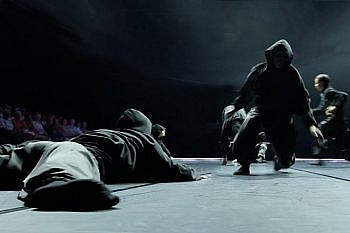
Claudia Virginia Vitari / Photo Alberto Giachino
The Max Planck Institute for Human Development in Berlin has recently hosted the solo exhibition of Claudia Virginia Vitari (Turin), an artist of Italian origin who has studied extensively in Germany. The exhibition is a collection of avant-garde visions resulting from years of research on subjects inhabiting the fringes of society. This project of incredible depth offers us the opportunity to closely observe otherwise inaccessible realities, landscapes that Vitari presents under the magnifying lens so essential in our historical moment, bringing us closer to those who are otherwise unreachable.
Vitari’s work stands out for the complexity of her field research, her experimental artistic techniques, and her critical application of robust philosophical and anthropological theories.
Briefly introducing the foundations of Claudia Virginia Vitari’s work inevitably leads us to discuss Michel Foucault and “The Origins of Inequality,” one of his most famous treatises in which he introduces the concept of social structure as the primary cause of a hierarchical social system responsible for class division.
The French philosopher, in his exploration of socially oriented philosophy and analysis of its structure and functioning, employs in another important book, “Discipline and Punish”, the architectural design of Jeremy Bentham’s ideal prison, rewriting it as a metaphor for the modern social model based on social control, the inevitability of punishment, and extreme discipline.

Claudia Virginia Vitari / Photo Alexander Schippel

Claudia Virginia Vitari

Claudia Virginia Vitari / Photo Lukas Kuich
The “Panopticon” (the name of Bentham’s architectural project) envisions constant surveillance of prisoners housed in small cells arranged in a circular structure around a single central observation tower. This model ensures that prisoners are perpetually, albeit unknowingly, observed. Foucault uses this architectural design as a conceptual model to describe the functioning of modern institutions: hospitals, schools, and factories, which, according to Foucault, operate to promote individual control through surveillance and spatial organization.
This theoretical tradition forms the basis of the critical approach and profound reflection that characterizes Claudia Virginia Vitari’s over decades-long work on interstitial spaces—the liminal zones formed at the edges of socially accepted categories.
Vitari’s monumental work, an anthropological field study unfolding within these marginal spaces, culminates in the solo exhibition “Panopticon” hosted at the Max Planck Institute for Human Development in Berlin.

Claudia Virginia Vitari / Photo Janine Mapurunga

Claudia Virginia Vitari / Photo Janine Mapurunga

Claudia Virginia Vitari / Photo Janine Mapurunga
Vitari’s research is primarily driven by the artist’s need to study social margins and borderline situations, investigating social tensions in institutional structures aimed at “normalization,” control, and the re-education of individuals expelled from accepted social norms.
Vitari immerses herself personally in prisons, migrant reception centers, and psychiatric institutions (such as Halle an der Saale, Germany, and the “Lorusso e Cotugno” Detention Center in Turin), collecting research material for three of her most important exhibitions: “Percorsogalera” (2007–2009), “Invisible Cities” (2009–2012), and “Interstitial Identities” (2021), all featured in the major solo exhibition in Berlin.
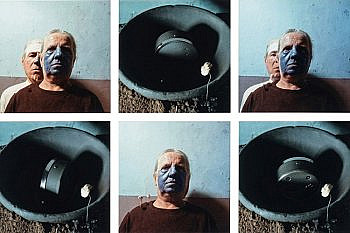
The retrospective offers an overview of Vitari’s work: the result of research carried out with extreme sensitivity and precision, enabling the artist to develop a perspective born from personal engagement yet presented to the public with a rigor akin to scientific methodology. Vitari’s unsettling and essential art combines this dual approach in works composed of large, complex structures in which metal supports intertwine with glass sculptures crafted using sophisticated experimental techniques, further complemented by drawings and portraits of the subjects Vitari encountered during her research.

Claudia Virginia Vitari / Photo Janine Mapurunga

Claudia Virginia Vitari / Photo Janine Mapurunga

Claudia Virginia Vitari / Photo Janine Mapurunga
The artist’s human dimension – rich and self-aware – manifests in her initial attempts at personal contact and dialogue with the individuals at the heart of these interstitial categories, reflected in the series of portraits she creates to establish a first form of rapport. The human connection and proximity to her subjects, her willingness to listen, and her absence of prejudice are essential features of the ethnological research that defines Vitari’s meticulous work, as well as an invitation to adopt a stance far more common among those who have never encountered social marginalization.
Thus, while the visual result consists of metaphorical eyes supported by imposing metallic frameworks, magnifying glasses aimed at the faces portrayed, molds encased in rigid metal cubes, and monumental installations paired with biographical writings, the metaphorical outcome is a diagonal and unprecedented perspective on typically stigmatized areas. It invites us to change the lens we are accustomed to and look beyond the stigma of those who have been condemned and isolated.
Grounded in the philosophical traditions of Michel Foucault and Erving Goffman (among others), Vitari’s artistic project reflects on the failure of rigid, impermeable social classes and the restoration of dignity to those inevitably excluded.
The theoretical insights are clearly recognizable, and the products of a complex and refined artistic technique, offering a unique and otherwise inaccessible perspective on social systems and human rights, are deeply appreciated. It underscores the need for a bureaucracy that seems to have become a prerequisite for the recognition of humanity itself.

Claudia Virginia Vitari / Photo Alexander Schippel

Claudia Virginia Vitari / Photo Michele Casagrande
Thus, the metal structures become metaphors for the mechanisms of social constructions, while the blown-glass sculptures serve as magnifying lenses focused on those rendered invisible, eyes wide open, supported by a vast universal plane that seems to have forgotten the weakest, the marginalized, and the outcasts, isolating them in a limbo from which escape seems impossible without stain or stigma. Vitari gives voice and form to those who seem to have lost it in the machinery of bureaucracy and collective memory, producing work of extreme conceptual depth and technical complexity that begins as ethnographic research and becomes art.
The artist ignites the spark of the social revolution we so desperately need, a thoughtful and intelligent revolution, that compels us to be present where no one has wanted to be, to look at those we have always ignored through a vast, crystal-clear magnifying glass. Claudia Virginia Vitari opens the doors to otherwise closed and impermeable spaces, inviting us to closely observe things and people we have evidently lost sight of, responding to the contemporary social imperative of redistributing civil rights, the need to listen, and the human right to be seen and recognized.
Claudia Virginia Vitari: Panopticon
November 22, 2024 – January 17, 2025
Max Planck Institute for Human Development
Visit the website >