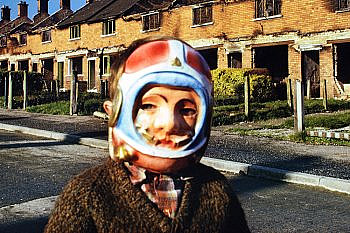
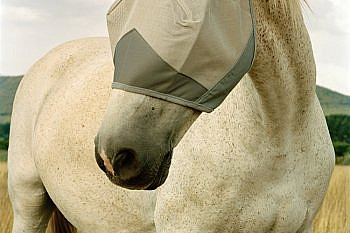
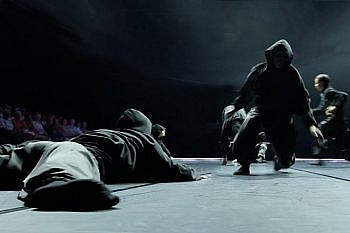
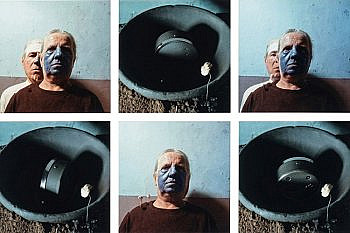
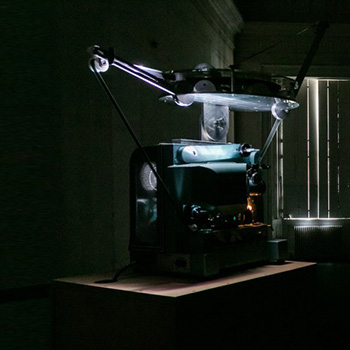
Tobias Zielony, Line, 2016-2017 © Tobias Zielony
Most of us here in Western societies are living in relative safety and freedom from suffering – and thus in a bizarre contrast to people who find themselves in areas marked by humanitarian crisis or war. For many, the resulting discrepancy gives rise to a feeling of powerlessness, while at the same time we resort to escapism in order to cope with the disparity between these two worlds. Though a sense of moral obligation stands in stark contrast to exuberant parties and celebrations, the latter have always been a source of social bonding and liberation.

Tobias Zielony, Shine, 2017 (detail), © VG Bild-Kunst, Bonn 2024, Courtesy the artist and KOW, Berlin

Dance, Dance, Revolution, Photo: Jaewon Kim; in the foreground: Iza Tarasewicz, Revelation of Powers, 2022, Courtesy the artist and Gunia Nowik Gallery, Warsaw; in the background: Tobias Zielony, Maskirovka, 2016-17, © VG Bild-Kunst, Bonn 2024, Courtesy the artist and KOW, Berlin

Tobias Zielony, Make Up, 2017, From the series Maskirovka, Inkjet-Print, 70 x 105 cm. Courtesy of KOW, Berlin © Tobias Zielony
The group exhibition Dance, Dance, Revolution at Kunsthaus Hamburg explores dance as a dynamic form of protest. Against the backdrop of the ongoing Russian full-scale war in Ukraine, the participating artists negotiate dance, rhythm and sound as an emancipatory act of collective resistance. Based on media spanning photography, installation, video and sound, an arc is drawn from traditional folk dances to contemporary raves.

Installation view Dance, Dance, Revolution, Photo: Jaewon Kim; in the foreground: Anna Potyomkina, Dances at the Dead. Archive., 2023, ongoing; in the background: Tobias Zielony, Rynok from the series Maskirovka, 2017, © VG Bild-Kunst, Bonn 2024, Courtesy the artist and KOW, Berlin

Mykola Ridnyi, The Battle over Mazepa, 2023, Video still

foreground: Iza Tarasewicz, Looped Processions II, 2022, Courtesy the artist and Gunia Nowik Gallery, Warsaw; background: Roman Khimei & Yarema Malashchuk, Dedicated to the Youth of the World II & III, 2019 und 2023, Courtesy the artists
In her personal video compilation Dances at the Dead. Archive (2023, ongoing), dedicated to her friend Yura Stetsyk who died in the war, Anna Potyomkina examines the desire for excessive celebrations in relation to traditional customs. Already in pre-Christian times, the Hutsuls, a Ukrainian ethnic group from the Carpathian Mountains, would turn even the saddest events – funerals for instance – into humorous spectacles. Iza Tarasewicz’s large-scale sculptural installations Revelation of Powers (2022) and Looped Processions II (2022) pay homage to the collective resistance underlying peasant uprisings and folk dances while also alluding to the blockade of grain deliveries from Ukraine by Russian invaders. In his video installation The Battle over Mazepa (2023), Mykola Ridnyi uses rap as a musical vehicle to shed light on differing interpretations and contradictory narratives of Russian-Ukrainian history.

Mykola Ridnyi, The Battle over Mazepa, 2023, Video still

Installation view Dance, Dance, Revolution, Photo: Jaewon Kim; in the foreground: Iza Tarasewicz, Looped Processions II, 2022, Courtesy the artist and Gunia Nowik Gallery, Warsaw; in the background: Tobias Zielony, Maskirovka, 2016-17, © VG Bild-Kunst, Bonn 2024, Courtesy the artist and KOW, Berlin

Older Than The Sun / Performance by Nabiki at Kunsthaus Hamburg
The photo and video series Maskirovka (2016–2017) by Tobias Zielony focuses on the queer underground and techno scene in Kyiv in the post-Maidan era, while making reference to Russian war tactics of deception and disinformation known by the same name. Roman Khimei and Yarema Malashchuk likewise pick up on club scenes in their video installation Dedicated to the Youth of the World II & III (2019, 2023), particularly the internationally known Cxema raves they documented in 2019 and 2023. The 2023 reenactment sought to grasp the new reality that no one would have imagined four years earlier. The Óstov Collective, in turn, received over a hundred audio recordings in response to an open call to capture the sound of war in 2022 after the Russian full-scale invasion of Ukraine. From the snippets they put together the sound installation Why do we always sing sad songs? II (2024), a piece that renders traditional dance music, prayers and the sounds of war audible and resonates as a collective experience far beyond Ukrainian borders.

Tobias Zielony, Figure, 2016-2017 © Tobias Zielony

foreground: Mykola Ridnyi, The Battle over Mazepa, 2023, Courtesy the artist

Anna Potyomkina, Dances at the Dead. Archive., 2023, ongoing, Video still
The title of the exhibition refers to the eponymous novel by Dutch-Ukrainian writer Lisa Weeda, whose protagonists are able to revive the dead through dance. Dancing becomes a universal language for all those who rely on nothing but their own body – powerful, energetic, authentic. In Dance, Dance, Revolution, the expressive power inherent in movement symbolizes lived feelings, a sense of belonging and cohesion. Dance allows us to escape reality for some fleeting moments, lets us feel connected with others and strengthens a conscious response to injustice and war through solidarity.
Dance, Dance, Revolution
August 10 – October 13, 2024 / Kunsthaus Hamburg
Visit the exhibition page >