David Correa: Un gran amor por la Bomba / Queue Gallery
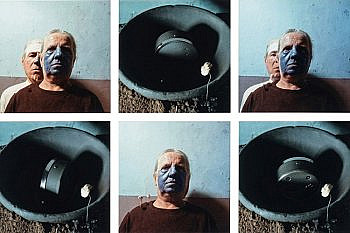
David Correa’s exhibition “Un Gran Amor Por la Bomba” (A Great Love for the Bomb), shapes the human need for a superior being into an aesthetic experience.
The artist structures the exhibition as a complex system of semantic displacement, a display articulated through numerous theoretical references such as Jean Baudrillard’s “Simulacra and Simulation” and Ursula K. Le Guin’s “The Carrier Bag Theory of Fiction”, staging a mise-en-scène that reconsiders the atomic bomb as a supreme artificial divinity.
At the core of Correa’s exhibition lies human activity, analyzed through three cultural axioms: anthropology viewed through a critical lens toward structuralism; the archetype of the dominant white male, embodied in the figure of the Cowboy as an expression of the anthropological ideology of Manifest Destiny; and the sacrificial victim, the necessary protagonist of the victor – vanquished duality.

David Correa: Un gran amor por la Bomba / Queue Gallery

David Correa, Fatman Study 01, 2025

David Correa, Hyperdeath Study 02, 2025

David Correa, Hyperdeath Study 03, 2025
The very structure of the exhibition is based on a continuous mimetic exercise in which an actor, an object, or the ensemble of works stands in for something else. It is the semantic transposition of abstract concepts or theories, a narrative that Correa unfolds with subtle yet ruthless critique, participating himself in a performative play composed of multiple media and emphasized by the works and installations within the space.
Correa begins from an analogical relationship that sees the atomic bomb as a substitute for the Sun God, universal and eternal, but in an enhanced version, as it is an artificial product of humankind itself. His work critiques the dominant social and economic structure in which divinity historically identified with the Sun God is replaced by the bomb: a perfected god because it can be reproduced, controlled, and because it is the offspring of the very human who generated it.
Drawing on anthropological paradigms within a narrative display capable of reflecting and manifesting the human need for deities, Correa suggests that in modern society transcendence and the superior dimension are embodied in the product and the artifact. In this sense, the atomic bomb becomes the modern god, bearing within itself the mark of its own death: a bomb created to kill and destined to die by killing.

David Correa, I Venture with boldness and love, scaling mountains in your name, 2025

David Correa, Left Wing of Fission/Right Wing of Fusion, 2025

David Correa, Obliteration, 2024

David Correa, Little Boy and Bluegill Prime, 2025
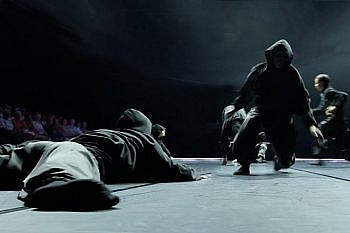
Within the exhibition space, the bomb-victim lies on the floor after detonation, embodied in a naked, crouched body stretched upon its own ruins and constantly filmed by a camera. Cables on the floor connect the bomb-body to the device, allowing its post-mortem image to be reproduced on a screen on the front wall. The camera captures images of The Bomb and sends them to a laser engraver installed on the wall; the laser then draws the image onto a sheet of drywall beneath it. After each engraved section, the image is gradually replaced by that from the Artist/Cowboy.
The Cowboy is a fictional character extrapolated from the theory of Manifest Destiny, a political-cultural ideology developed in the United States in the first half of the nineteenth century, which claimed that American territorial expansion westward was inevitable, providential, and morally justified.
Manifest Destiny conceived conquest as the foundation of American society – an expansionist and nationalist capitalism sustained by a distant and morbid anthropological gaze that, in the name of democracy and civilization, legitimized the expropriation of land and the exploitation of Native populations.

David Correa, For God and Country, 2026

David Correa, They know not where I hail from for I was here before God, 2026

LEFT: David Correa, Thanatos, 2026 / RIGHT: David Correa, Arrowhead II, 2026

David Correa, Transmission Valve Body and Housing Chamber, 2025

David Correa, The Bomb and the Cowboy, 2025
The figure of the Cowboy acts within the display by embodying these ideologies, using action and personification as semiotic substitutes. If the Cowboy operates in this way, the bomb instead represents the sacrificial dimension of the product: the suicide triggered by its own creator, who both performs and undergoes the detonation.
In this regard, Correa refers to the case of Bluegill Prime, a 1962 experiment conducted to study the effects of a thermonuclear explosion in near-Earth space. A failed preliminary explosion preceded the successful repetition of the test, in which the bomb appears as a man-made sun, a perfected artificial divinity.
In its creation, failure, and repetition toward perfection, Correa identifies the drive toward uncompromising efficiency: a semantic transposition of a productive system built upon slavery and exploitation. This critique addresses the matrix of an economic system based on the sacrifice of the working body and on migratory flows essential to the construction of American capitalism. The artist underscores this theme through the placement of a copy of Gustave Caillebotte’s *Les Raboteurs de parquet* (1875) within the exhibition space.
Drama, passion, and ruin are themes that can be contextualized within “Un Gran Amor por la Bomba”, a display that embodies and enacts the actions and consequences of a dualism in which victor and victim are propelled by the human tendency to seek divinity, translated here into a context in which humanity itself creates that divinity: optimal, efficient, subordinate, and capable of delivering to the viewer the apocalypse of omnipotence.
David Correa: Un gran amor por la Bomba
February 4–11, 2026 / Queue Gallery, Mexico City, Mexico
Visit the website >