

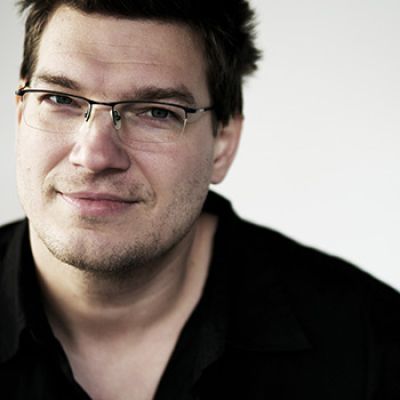
Nikolaus Geyrhalter is one of world cinema’s most renowned and celebrated documentary filmmakers. Famous for his unmistakable style which draws on calm, carefully framed wide shots with an eye for geometric compositions, his films eschew commentary or music to create visually striking accounts of places at the margins of our perception while, at the same time, cataloging social phenomena and periods of upheaval in a cinematically epic fashion.
Geyrhalter’s static-camera, well-paced observational films tackle their subjects head-on. Whether it’s exploring the terrain of post-disaster Chernobyl (Pripyat), reflecting on a post-human world (Homo Sapiens), or investigating modern day food production (Our Daily Bread), Geyrhalter’s films are nothing short of startling works of art.

Nikolaus Geyrhalter is one of world cinema’s most renowned and celebrated documentary filmmakers. Famous for his unmistakable style which draws on calm, carefully framed wide shots with an eye for geometric compositions, his films eschew commentary or music to create visually striking accounts of places at the margins of our perception while, at the same time, cataloging social phenomena and periods of upheaval in a cinematically epic fashion.
Geyrhalter’s static-camera, well-paced observational films tackle their subjects head-on. Whether it’s exploring the terrain of post-disaster Chernobyl (Pripyat), reflecting on a post-human world (Homo Sapiens), or investigating modern day food production (Our Daily Bread), Geyrhalter’s films are nothing short of startling works of art.



-
Eija-Liisa Ahtila: A Possible ImageOct 3, 2026 – Jan 31, 2027In the exhibition A Possible Image – of what is just becoming reality, Eija-Liisa Ahtila explores the interplay between humans and other forms of life within the ecological realm, and how we might understand change.
-
Ukraine, le mal qui reste / Guillaume HerbautOct 8 – Nov 29, 2026From October 8 to November 29, 2026, the Académie des beaux-arts will host the exhibition Ukraine, le mal qui reste (Ukraine, the Evil That Remains) by Guillaume Herbaut, winner of the 2024 Marc Ladreit de Lacharrière...
-
The Other Side of the MountainOct 14, 2026 – Mar 21, 2027
The Other side of the Mountain brings together contemporary artists working across the African continent and within the Afro-Nordic diaspora. They explore how cities and modern landscapes shape our connections to one another…
-
39th Panorama of Brazilian ArtSep 12, 2026 – Jan 24, 2027Entitled After It’s All Said, 39th Panorama of Brazilian Art, under the curatorship of Diane Lima, questions where artistic production has overflowed in the search to expand the limits of aesthetic representation through a radical exercise of imagination.
-
Suki Seokyeong Kang: Mountain – Hour – FaceOct 30, 2026 – Jan 24, 2027Featuring nearly 40 works created between 2014 and 2024, “Suki Seokyeong Kang: Mountain—Hour—Face” is the first solo exhibition by a South Korean artist in the McNay Art Museum’s history.
-
Chiara Camoni, The Flowers of EvilOct 9, 2026 – Jan 26, 2027
For its second exhibition since the opening of its Roman space, La Società delle Api presents I fiori del male, a project dedicated to the work of Chiara Camoni and curated by Alice Motard…
-
Ana Cavagna MartinezArtistAna Cavagna Martinez is an Argentinian artist, continuously inspired by nature, books and her philosophical studies. She has spent the last 20 years out of Buenos Aires, going through trips and moving all around the world.
-
Dario MaglionicoArtist / PainterDario Maglionico was born in Naples in 1986. After graduating in Biomedical Engineering at the Polytechnic University of Milan, from 2014 he lived and worked in Milan, devoting himself exclusively to painting.
-
Lundahl & Seitl: The Earths Within UsNovember 2–28, 2026Swedenborg House is pleased to announce The Earths Within Us (2026) by Swedish artist duo Lundahl & Seitl, a limited run of site-sensitive embodied performances at the historic home of the Swedenborg Society throughout November.
-
Mohammed Sami: HostlessOct 3, 2026 – Jan 3, 2027In his new body of work Hostless, Mohammed Sami focuses predominantly on internal spaces. The paintings become a site for mnemonic processes, mental operations in which abstraction falters and something unsettling begins to seep through.
-
Visionary LandscapesOct 1 – Dec 16, 2026Swedenborg House is pleased to announce Visionary Landscapes, an exhibition exploring the relationship between landscape, imagination and visionary states. Curated by Museum Director Stephen McNeilly, the exhibition brings together historic works in dialogue...
-
Ordinary GriefA Story of ReconciliationOrdinary Grief is a story of tenuous reconciliation. In 2017, I returned to Iran after 25 years of self-exile, where I embarked on a personal and political reclamation of my identity and history.
-
30 Under 30 Women Photographers / 2026 TAWNov 1 – Dec 12, 2026At the occasion of and in collaboration with Torino Art Week, Artpil proudly presents the online exhibition of the 17th Edition of the annual selection of 30 Under 30 Women Photographers 2026 taking place November 1 – December 12, 2026....
-
Ryuichi Sakamoto | Seeing Sound, Hearing TimeOct 31, 2026 – Mar 14, 2027Ryuichi Sakamoto | seeing sound, hearing time surveys the pioneering artistic practice of the late composer and artist Ryuichi Sakamoto (1952–2023) from the 2000s onward. The exhibition illuminates how Sakamoto transcended the boundaries of sound, image, digital technology...
-
Luciano Fabro: Inhabiting SpaceOct 8, 2026 – Feb 21, 2027Pirelli HangarBicocca presents Abitare lo spazio: Inhabiting Space, the first museum retrospective dedicated to Luciano Fabro in Italy since the artist’s death in nearly two decades. The exhibition delves into the concept of “habitat”...
-
Julie Bullard / Nadia Lee Cohen & Martin ParrPublication
Julie Bullard, a work of photographic fiction by Nadia Lee Cohen and Martin Parr. The book is designed as a late-seventies photo album, closely modelled on an example acquired from eBay, complete with faux leather spongy board covers…
-
Sean Scully, 48Apr 18, 2026 – Dec 24, 2028LongHouse welcomes the world-renowned Irish American artist Sean Scully into the garden with his colored stack entitled 48, 2024, a work that epitomizes his deliberate use of stripes and color, with gestures toward land, sea, and sky.
-
Relic 4: Larry AchiampongOct 16 – Dec 12, 2026This autumn, Larry Achiampong will present his new film Relic 4 (2026) at KARST, revisiting the cinematic universe of the Relic Traveller project after a six-year hiatus. Exploring themes of fallen empire, class, and displacement...
Visit our New Announcement Submission page > Announcement Submission page >


