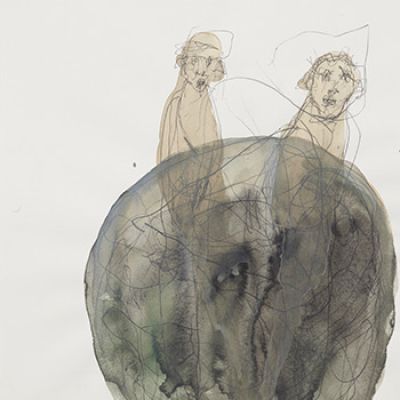
Thomas Lehnerer (1955–1995) was one of Germany’s outstanding artists from the 1980s. Although he died at an early age, he left behind an extensive oeuvre consisting primarily of drawings and small sculptures. But Lehnerer also always knew to combine and balance his artistic work with intense intellectual activity. His early years (around 1980–1987) were largely dominated by a religiously oriented engagement with the world, culminating in a dissertation in theology. He then turned increasingly to philosophical issues and developed his own art theory, summed up in his 1993 book Methode der Kunst (Methods of Art). Its central focus is the preservation of freedom in the field of tension between thinking, feeling and contextual contingency: the ‘free interaction’ among these components, in his view, allows for the emergence of art.
Lehnerer’s thought and artistic activity cycle around very existential issues dealing with the ‘big’ questions of human existence: life, death, love, God, sensuality and the relationship to nature and culture.
–Friedemann Malsch
Thomas Lehnerer (1955–1995) was one of Germany’s outstanding artists from the 1980s. Although he died at an early age, he left behind an extensive oeuvre consisting primarily of drawings and small sculptures. But Lehnerer also always knew to combine and balance his artistic work with intense intellectual activity. His early years (around 1980–1987) were largely dominated by a religiously oriented engagement with the world, culminating in a dissertation in theology. He then turned increasingly to philosophical issues and developed his own art theory, summed up in his 1993 book Methode der Kunst (Methods of Art). Its central focus is the preservation of freedom in the field of tension between thinking, feeling and contextual contingency: the ‘free interaction’ among these components, in his view, allows for the emergence of art.
Lehnerer’s thought and artistic activity cycle around very existential issues dealing with the ‘big’ questions of human existence: life, death, love, God, sensuality and the relationship to nature and culture.
–Friedemann Malsch



-
Argo: Movements of Inner and Outer NatureGwendolyn Hope GussmanArgo is a creative residency program and project space in Athens, Greece. We are open to visual artists, writers, performers, musicians, scholars, and any other creative discipline. Each residency includes accommodation, studio space, research support, and participation in a creative community.
-
Constellations: Contemporary Jewelry from the Dallas Museum of ArtJul 10, 2026 – Jan 3, 2027
“Constellations: Contemporary Jewelry from the Dallas Museum of Art” showcases more than 350 works from one of the most significant contemporary jewelry collections in the United States.
-
Alen MacWeeney: ANTHOLOGYDec 5, 2026 – Feb 7, 2027Photo Museum Ireland presents Alen MacWeeney: ANTHOLOGY, the landmark retrospective exhibition, and stunning new monograph by one of Ireland’s most significant photographers.
-
Afterlife Film ProgramSep 5 – Dec 18, 2026Death is one of the few universal experiences of the human condition and, at the same time, one of the most mysterious. Throughout history, religions, spiritual traditions, philosophical schools of thought, and even science have sought to answer the same question...
-
CameraItalian Center for PhotographyA project of international scope, undertaken in the autumn of 2015 with a range of private partnerships, CAMERA aims to reinforce its connection with the territorial system ever more: a unique hub dedicated to photography...
-
Mohammed Sami: HostlessOct 3, 2026 – Jan 3, 2027In his new body of work Hostless, Mohammed Sami focuses predominantly on internal spaces. The paintings become a site for mnemonic processes, mental operations in which abstraction falters and something unsettling begins to seep through.
-
Alain LaboilePhotographerBorn on May 1, 1968 in Bordeaux, France, Alain Laboile is a photographer and father of six. In 2004, as he needed to put together a portfolio of his work as a sculptor, he acquired a camera, and thus developed a taste for macrophotography...
-
Lu GuangPhotographerLu Guang was born in 1961, in Zhejiang Province, China. He has been passionate about photography since he held a camera for the first time, in 1980 when he was a factory worker in his hometown in Yongkang County.
-
Petra Collins: StarBy Gaelin Rosenwaks
Inspired by 16 years of shooting some of the biggest names in the music world, witnessing the rise and fall of pop icons, and watching descents into madness, Collins created two fictional music groups exclusively for this publication.
-
Luciano Fabro: Inhabiting SpaceOct 8, 2026 – Feb 21, 2027Pirelli HangarBicocca presents Abitare lo spazio: Inhabiting Space, the first museum retrospective dedicated to Luciano Fabro in Italy since the artist’s death in nearly two decades. The exhibition delves into the concept of “habitat”...
-
Oulu2026: PlayJan 14 – Dec 31, 2026Fotografiska Tallinn brings a photo exhibition to Finland for the first time. Entitled PLAY, the group exhibition is part of the European Capital of Culture programme...
-
Lundahl & Seitl: The Earths Within UsNovember 2–28, 2026Swedenborg House is pleased to announce The Earths Within Us (2026) by Swedish artist duo Lundahl & Seitl, a limited run of site-sensitive embodied performances at the historic home of the Swedenborg Society throughout November.
-
Chiara Camoni, The Flowers of EvilOct 9, 2026 – Jan 26, 2027
For its second exhibition since the opening of its Roman space, La Società delle Api presents I fiori del male, a project dedicated to the work of Chiara Camoni and curated by Alice Motard…
-
Foundation Eleutheria Launches During Art Basel ParisInternational cultural initiative
An international cultural initiative connecting contemporary art, cultural heritage, education and sustainability between The Bahamas, Paris and the wider world. Foundation Eleutheria launches…
-
Tiffany Sia: Overt ListeningNov 13, 2026 – Jan 24, 2027Kunsthalle Wien presents the first institutional solo exhibition in Austria by Tiffany Sia (b. 1988, Hong Kong). Overt Listening is centred around a new film which takes as its subject the Kinmen Islands in Taiwan, just a few kilometres off the Chinese coast.
-
Orgasmagoria by Dries VerhoevenNov 28, 2026 – Mar 6, 2027Starting November 28, Brutus Art Space will present Orgasmagoria (2026), an ongoing film by artist Dries Verhoeven about sexual gratification in the digital age. The work will premiere in November at the International Documentary Film Festival Amsterdam (IDFA).
-
Forever Marked By The DayJun 26, 2026 – Jan 3, 2027Reflecting on loss, resilience and the power of rebuilding, “Forever Marked By The Day: A Quarter Century of Mourning and Renewal” marks 25 years since the attacks on Sept. 11, 2001. Approached through an architectural lens, the exhibition fosters intergenerational dialogue...
-
Arnold J. Kemp: Not One ThingJul 28 – Dec 6, 2026
Arnold J. Kemp: Not One Thing is the first institutional survey of work by the Chicago-based artist Arnold J. Kemp (b. 1968, Boston). The exhibition focuses on Kemp’s performative and material tendencies of masking, traced through various media.
Visit our New Announcement Submission page > Announcement Submission page >