
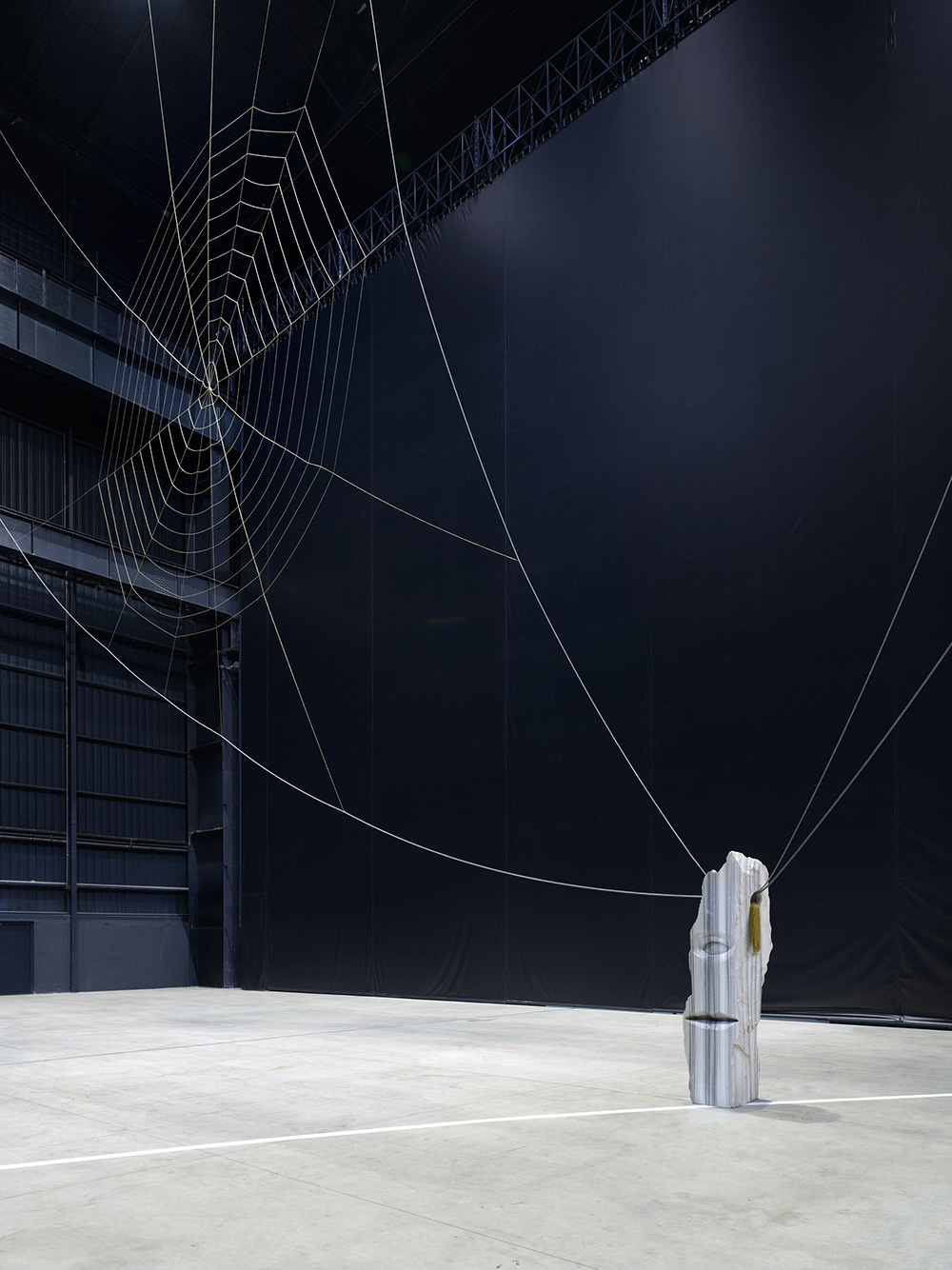
Pirelli HangarBicocca presents Abitare lo spazio: Inhabiting Space, the first museum retrospective dedicated to Luciano Fabro in Italy since the artist’s death in nearly two decades. The exhibition delves into the concept of “habitat”—the cornerstone of his perceptual and spatial research through an extensive presentation that brings together around fifty of the artist’s most significant sculptures and installations, tracing the entirety of the artist’s career.
A central figure in postwar Italian art, Luciano Fabro (Turin, 1936–Milan, 2007) was a leading member of the Arte Povera movement, while constantly maintaining an independent and nonconformist approach to artistic research. From the beginning of his career, he developed a distinctive approach to the notion of inhabiting space, conceived by the artist as a dynamic field of action, whilst examining the act of looking, the experience, and the relationship between the viewer, the artworks and the surrounding environment. He experimented extensively with the expressive potential of a wide range of materials, ranging from more traditional media such as marble, glass, and bronze to less conventional ones, such as silk and lead, each chosen for its sensory and evocative qualities.
More than a decade after his last major international exhibition at the Reina Sofía Museum in Madrid in 2014, the Pirelli HangarBicocca retrospective reflects on Fabro’s deep connection to Milan. In the late 1970s and early 1980s, he co-founded Casa degli Artisti with Hidetoshi Nagasawa and Jole De Sanna, and from 1983 to 2002 taught at the Brera Academy of Fine Arts, influencing generations of artists.
Titled, Abitare lo spazio. Inhabiting Space, the exhibition is the first museum retrospective dedicated to Fabro in Italy since his death in 2007. Curated by Fiammetta Griccioli, Roberta Tenconi, and Vicente Todolí in collaboration with Silvia Fabro Director of the Luciano and Carla Fabro Archive, the exhibition at Pirelli HangarBicocca brings together around fifty of the artist’s most significant sculptures and installations spanning the period from 1963 to 2006. Emphasis is placed on Fabro’s investigations into perception and spatial experience, initiated in the 1960s, tracing their development from his early experiments with reflective surfaces through the following fifty years. This evolution culminated in increasingly complex autonomous self-standing structures and spaces—often made of paper—which the artist referred to as “habitats”: ideal environments, either self-contained or integrated into existing architectures, conceived to house and activate his works.
The exhibition path in Pirelli HangarBicocca alternates individual works with large-scale environmental installations and habitats reconstructed according to Fabro’s original plans and instructions. It opens with La Dialettica, 1985, presented here as originally conceived for the Grande Halle de la Villette, and explores the notion of personal space through key works such as In cubo (1966) and Io rappresento l’ingombro dell’oggetto nella vanità dell’ideologia. Lo spirato (1968–73). At the center of the Navate stands the Habitat (di Rotterdam) (1981), faithfully reconstructed from Fabro’s retrospective at the Museum Boijmans Van Beuningen, with around twenty works displayed inside, including several of his renowned Italie. The concept of habitat, an environment in which the art pieces, architecture, and the human presence all contribute to create a whole, is described by Fabro both as a place “that must embody all our possible activities—imaginative, rational and emotional—but which, by doing so, stimulates us” and as a “refuge” in which to shelter and feel at ease. The exhibition then turns to cosmological and metaphysical conceptions of space, featuring Il Sole (1997), La Luna (1997), and Eclissi di Cielo (2006), shown here for the first time. It concludes in the Cubo with È la vita è la storia è la morale (1995), first presented at the 1997 Venice Biennale.
Luciano Fabro: Abitare lo spazio. Inhabiting Space
Oct 8, 2026 – Feb 21, 2027
Pirelli HangarBicocca
Milan, Italy

