Anne Louise Blicher, Grief Shrine of Growth – Two Moons
Anne Louise Blicher’s artistic practice is deeply rooted in site-specific research, incorporating the meaning, habitat, and history of places, often focusing on plants and their stories. Notable projects include Flora & Forces, which explores the invasive Rosehip’s presence in Denmark and its relationship with nature’s forces and human control. Her approach is based on graphic anthropology, an artistic method that maps surroundings through observation and imagination, emphasizing the interconnectedness of things. Her work consistently revolves around the themes of nature, memory, and the interplay between the human and non-human world, drawing inspiration from philosophical ideas about vegetal life and speculative aesthetics. I had the pleasure of interviewing, visiting studio of Blicher. This opportunity was supported by a grant from the Danish Arts Foundation’s Committee for Visual Arts as part of their “International Research Programme.”
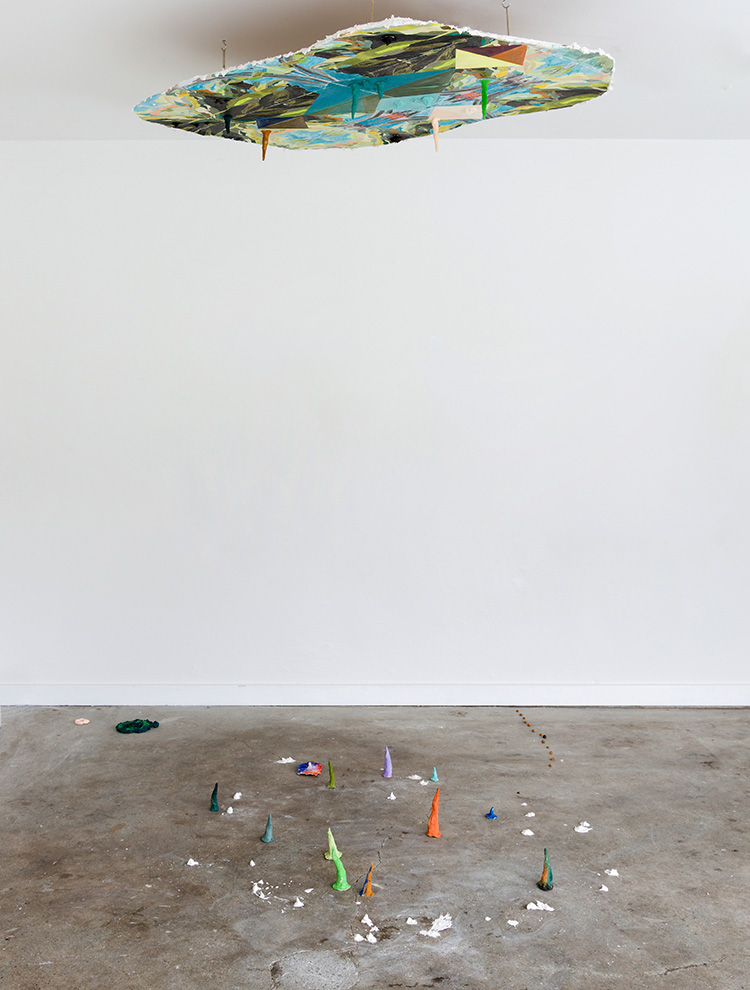
Anne Louise Blicher, Celestrial Territory. Atmospheric Agriculture. Photo Mikkel Kaldal
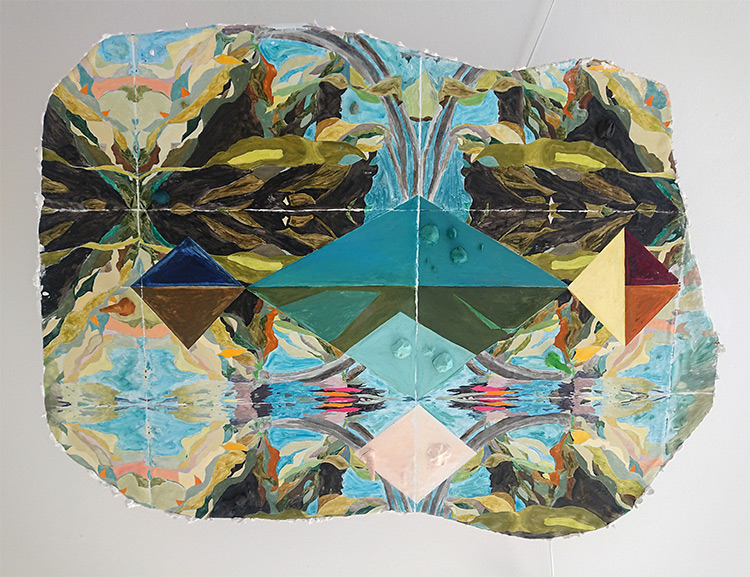
Anne Louise Blicher, Celestrial Territory. Atmospheric Agriculture
BY: Your work seems profoundly site-specific, focusing on the intimate details of local flora. Could you walk us through your process of selecting and studying the plants?
ALB: Initially I research the overall habitat of a place or of the site-specific context, as I try to include the meaning, habitat or history of a place in the visual expression. I’m curious about stories unfolding through the plants.
One example is the project Flora & Forces. It is based on site specific studies of the invasive Rosehip (Rosa Rugosa) growing uncontrolled by the coastline in the commune of Varde in relation to an exhibition at Kunsthal VARTe. The Rosehip rose was introduced as an ornamental plant from Asia in the 19th century to Denmark and was later used for coastal protection, as it is very hardy and tolerates salt. It was first observed lost/uncontrolled in Danish nature in 1875. The project focuses on the relationship between nature’s own forces, deities, and the power of man, and how invasive plants provide counter play to human control based on an understanding of nature as something cultivated. They are inspired by Marcus Terentius Varro’s meditations on farming in his treatise Res Rusticae (country matters) (37 BC), where he talks about 12 agricultural deities; nonhuman agents each possessing natural power and forces. Like Tellus Mater the goddess of the earth and territory and the land, and Flora the goddess of flowering and blossoming plants and new growth.
Another work still in the making is A Vertical Borderland; an art commission made for Danderyd Hospital in Stockholm. As the common focus area of the department at Danderyd hospital, BY61, Plan 3 is on stomach and gut problems, the overall art installation is focused on plants, which have been used as medicine to soothe and cure diseases and problems in stomach and gut through history: Geum urbanum/Herba Benedicta, Glycyrrhiza glabra/Liquorice, Acórus cálamus/Sweet flag. Through reflections, repetitions and other renderings and unfoldings of the plant motives, I work with alternative perspectives creating virtual openings for dwelling experiences of something familiar like plants but rendered in alternative ways. The artistic idea is to create ‘glades of growth and light’, which will grow from the walls of the hospital corridors inviting the passerby ‘inside’ into a vertical borderland that is familiar yet creating a dreaming feeling.

Anne Louise Blicher, Cosmic Causality
One last example I want to mention is Pink Asphodel. The story of a place can often be found growing in the cracks. As the botanist Richard Deakin points out in Flora of the Colosseum of Rome: ”Flowers form a link with memory.” (Deakin,1855: vi PREFACE) This project is about the Onion-leaved Pink Asphodel (Asfodelo Fistolosus), which unfolds a very interesting story: ”This pretty little plant grows on the upper part of the ruins of the Colosseum, which is the only place that it is known to grow in about Rome.” (Deakin, 1855:196) For centuries Colosseum was a wild and overgrown place. When Deakin examined Colosseum in the 1850s, he found a wide variety of species of plant growing among the ruins. Several species encountered were rare for the flora of Rome, as in particular the Pink Asphodel. But how did this flower come to grow in Colosseum? The myth goes that the plants were brought as seeds on the fur of animals brought from Africa to fight in the arena, where the animals died in large numbers. One example is the games celebrating the inauguration of the Colosseum in Rome, arranged by the Flavian emperor Titus, where 9000 animals were killed in the arena during the 100 days celebration. Another theory is that the seeds have been transported with stones used for constructing the arena, as rare flowers have been found growing at other historical sites like for example Ostia Antica. The site-specific observations and following transcriptions were supplemented by detail studies of the Pink Asphodel done visiting The Museum Herbarium of Molise (MEM) in Rome.
This leads me to the second part of your question – I often supplement the historical research with still life observation – also due to my classical training in drawing and painting.
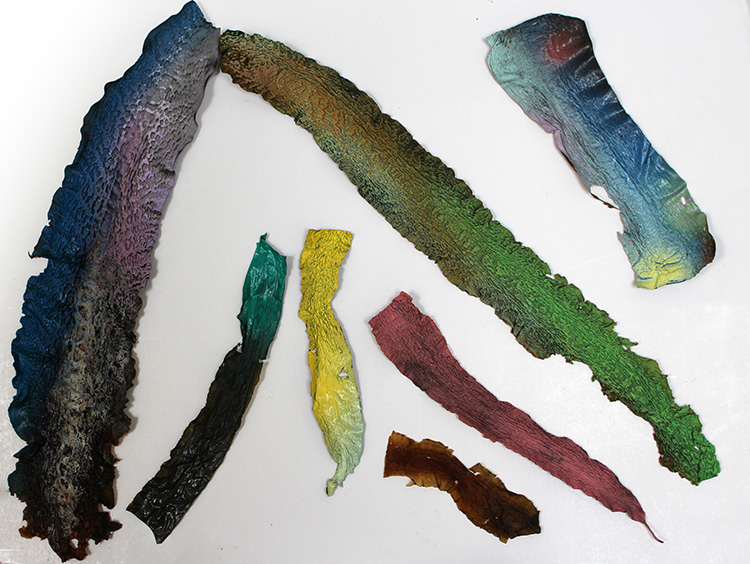
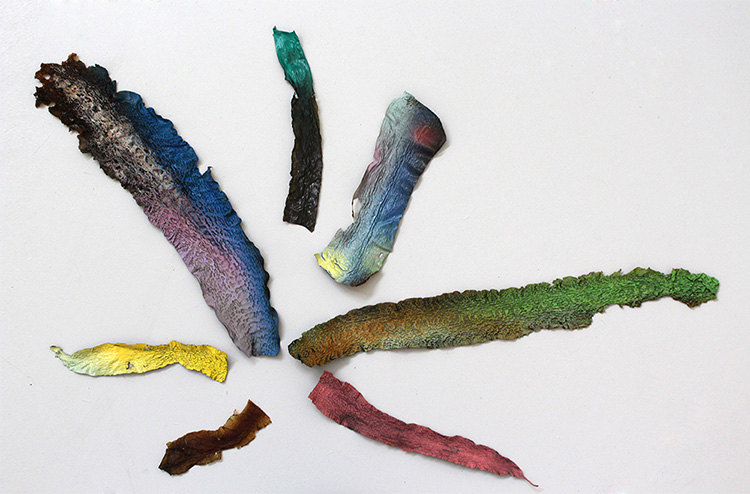
Anne Louise Blicher, Kelp Star composition decomposed
In general, my approach is based on graphic anthropology as an artistic method to map out the surroundings as a sensed space based on on-site inscriptions and post-site transcriptions. It is an earthbound, embodied imaginary drawing technique. It means that a line is not important because it records what you see, but what it leads you to see. By observing and being towards something over time an indexical connectedness occurs; a ‘thinging of things’ as Heidegger describes it, where imagination and memory meet. You are called by the thing; ‘bedingt’ in a ‘mirror-play’, where things get present. You become what you draw, not in form but in emotion.” As such graphic anthropology is both a method and a metaphor. As a metaphor it is about ‘togethering’. How, by using inscriptive practices, we get closer to our surroundings based on a mirror-play is supported by recent research in neuroscience about mirror neurons and empathic simulation, which equate human and nonhumans by showing that our simulation pattern is the same, be it a three, a house or a person we interact with. (Mallgrave, 2015). Methodologically it is an inscriptive observation technique consisting of in situ inscriptions characterized by a temporal togethering with the observed and post-situ renderings; synthetic transcriptions of data like maps, photos, film scenes and diagrams to reach beyond the documentary.
BY: Considering the growing interest in critical plant studies and the philosophical challenges posed by works like Michael Marder’s Plant-Thinking, how do you philosophically engage with plant ontology in your art? How does this philosophical engagement shape the narratives or themes you explore in your work?
ALB: First – by using ‘critical’ as a part of my approach – for me is a way to address or focus on climate issues as well. For the specific ontological plant-part – like Marder I believe in the wisdom of plant. I do share an ontological concern with vegetal life, and I try to attend to plants on their own terms. As Tristan Garcia points out in Form and Object – A Treatise on Things it is possible to extend the property of intentionality to all things instead of defining an object by its non-intentionality or making an object an apriori privilege of consciousness. Likewise, Marder talks about a non-conscious intentionality opposite Husserl’s non-intentional consciousness, as it lacks directionality. As Marder puts it, the non-conscious life of plants is a kind of “thinking before thinking”. Though personally I would rather define vegetal memory in plants and the pre-reflective intentionality of nourishment (the act of a plant thriving toward the sun) as based on intuition similar to Deleuze’s “body without organs” and Merleau Ponty’s “brute being” as something to be sensed at the limit of the body/thing through the body without organs [1] in the brute being beyond [2] surpassing the physical sensory perception but instead based on intuition; the will of phantasy to understand what happens in a person/what the imagination does in the object.
Overall, my practice is based on non-representational theory and the concept ‘worlding’; a blending of the material and the semiotic that removes the boundaries between subject and environment. I support speculative realism’s belief in an a priori representations of ’things-in-themselves’, but not like Object Oriented Ontology’s understanding of things like pre-existing solid units. On the contrary, I imagine existence as something that is carved out of an inherent ontological indeterminacy consisting of real virtual intensities. This means that I understand the world as consisting of ‘things-in-phenomena’ as in Karen Barad’s agential realism, where everything comes to exist in intra-action. Like Katherine Hayle’s talks about a ‘speculative aesthetics’, where an object’s intra-acting with other things is a partly representation of its distinct characters. Any meeting is unique depending on its appearances, and the kind of qualities that are actualized in the meeting. As Deleuze and Guattari describes it, the virtual must be defined as a part of the real object – as though the object had one part of itself in the virtual into which it plunged as though into an objective dimension consisting of differential elements and relations that are concretized in actual meetings. The reality of the virtual is a structure. As such I work from an understanding of nature as virtual and designed, not as fake but as a foundation; as a sensed ecology of inherent structures, potential connections and resonances to be activated.
My philosophical take-off makes it natural for me to visually study and portray vegetal life dynamics like germination, growth, reproduction, and decay together with concepts like invasive crops, foreign soil, and geographic borders as well as nature’s inherent geometric, quasi-crystalline and entropic structures and systems.
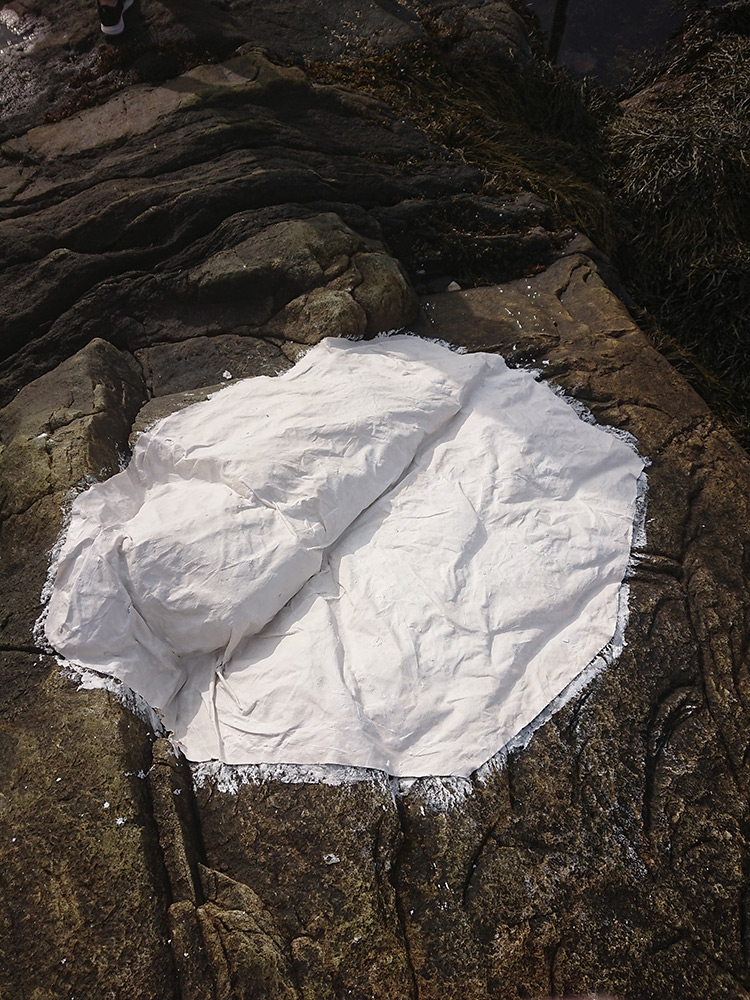
Anne Louise Blicher, Vertical Imprint
BY: You’ve incorporated textile in your exploration of organic forms. What inspired you to expand into this medium, and how does it complement your approach to especially to printmaking?
ALB: I have experimented with different kind of papers from Japanese papers to Lokta paper, which led me to woodblock printing on textiles. Recently I have worked with tulle – see the text about the Grief Shrine below. I’m interested in the future to test layerings of cloth and paper-print inspired by the traditional Korean Bojagi quilting.
BY: As you look to the future, what projects or themes are you excited to explore? Are there specific environments, subjects, or artistic techniques you are eager to delve into in your upcoming works?
ALB: My work is rooted in a sculptural painting practice. I combine classical painting techniques with a spatial and often vertical perspective. I am interested in a vertical embodiment of space; in the way the body relates to a work when it is both a painting and an installation. My latest commission, still not official, is taking my practice further in this direction.
It will consist of a pavilion surrounded by ‘plant columns’ placed in the green course in a shopping street inspired by the history of the city as a gardener’s town based on the motifs of roses, scarlet cabbage and kale. The pavilion will be designed as a nine sided partially open construction in anodized aluminum, with a top grid inspired by the fibonacci spiral in which enamel plates with silhouette shapes of kale and roses and a hand-painted center motif are mounted. The plant leaf plates grow up and down from the top on stems of different lengths. You can sit or lie on a rock cast in concrete placed inside the pavilion and look up at the leaves, which compositionally overlap each other like leaves in a tree crown, as well as view the composition from above from the surrounding apartments. A sitting sculpture casted in concrete is placed in the pavilion. It will function as a kind of rocking stone, on which you can lie and look up into the crown of enamel leaves or sit on the edge. Green plant columns will spread out like shoots from the pavilion. They are free-standing enamel sculptures mounted on playful platforms cast in concrete in the style of the seating architecture. The idea is to unite calm; a place of contemplation with a playful touch; green loopholes for body and mind.
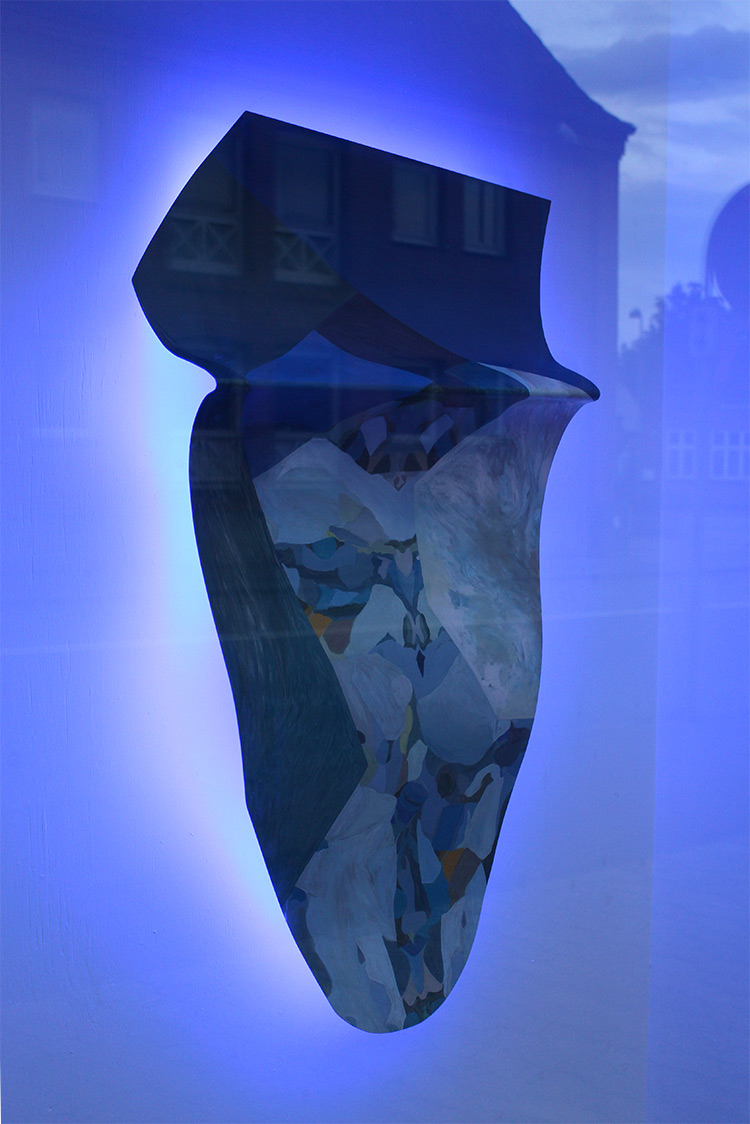
Anne Louise Blicher, Vertical Ocean
Recently I have also become interested in the vertical dimension as an aesthetic field in healthcare design, wondering why this dimension is almost non existing in the care sector, where people are often bedridden. Can ceiling decorations function as bodily curing prosthetics? In this regard I would like to work with digital augmentation as well. Where art becomes a component in an emotive language, which is surgically set to support an emotional stage for the individual person to create ‘responding vertical sculptural images’ based on the bodily state of the patient.
In the future I dream about cultivating ‘affective atmospheres’; to stage sculptural conditions that articulate the presence of things based on an embodied appropriation of space, a being-of-the-air. We inhabit the air through the atmosphere designed by plants. As such atmosphere is an act of gardening. Like in Emanuele Coccia’s “Cosmic Garden”, where the atmosphere is the core not the earth. Coccia reminds us that plants have transformed the atmosphere, facilitating the emergence of forms of life. He proposes an inversion of the model of gardening. He understands gardening as the production of atmosphere itself. While our western conception of the gardening activity tends to focus on the practices and crops, we develop on the ground, the main gardening activity of the plants doesn’t operate on the ground but first and foremost in the air. The process of this upside-down terraforming reached its peak during what is called the Great Oxygenation Event (GOE), made possible by the breathing of the plants that millions of years ago, which moved from the water to the air. Unlike the organisms which came before them, they used a process known as photosynthesis to gain energy. Today, most plants use photosynthesis to live – they absorb sunlight for energy and produce oxygen as a waste product. As such atmosphere is an act of gardening. In that sense, the plants are the real gardeners, since they produce what we understand as the atmosphere by the processes of photosynthesis.
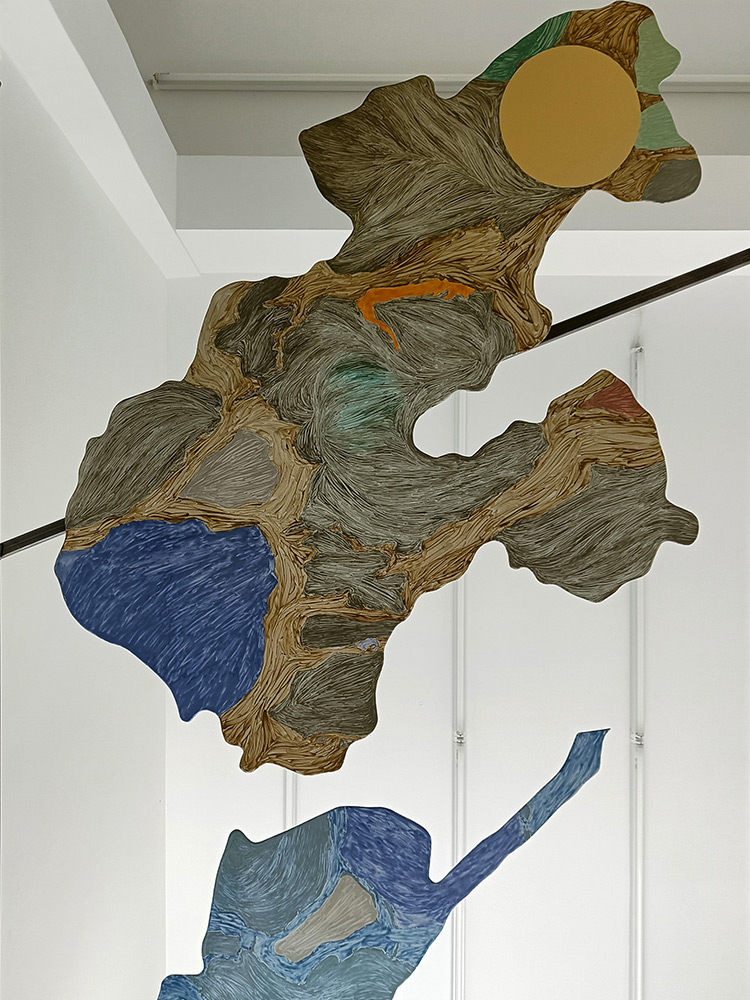
Anne Louise Blicher, Grief Shrine of Growth – Two Moons
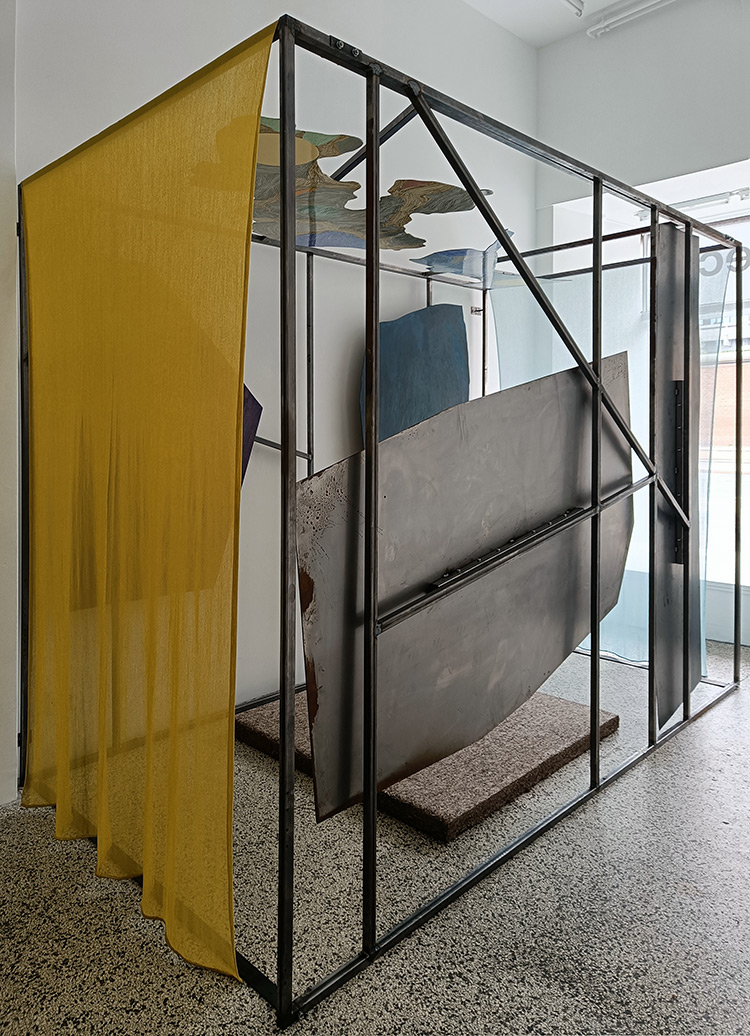
Anne Louise Blicher, Grief Shrine of Growth – Two Moons
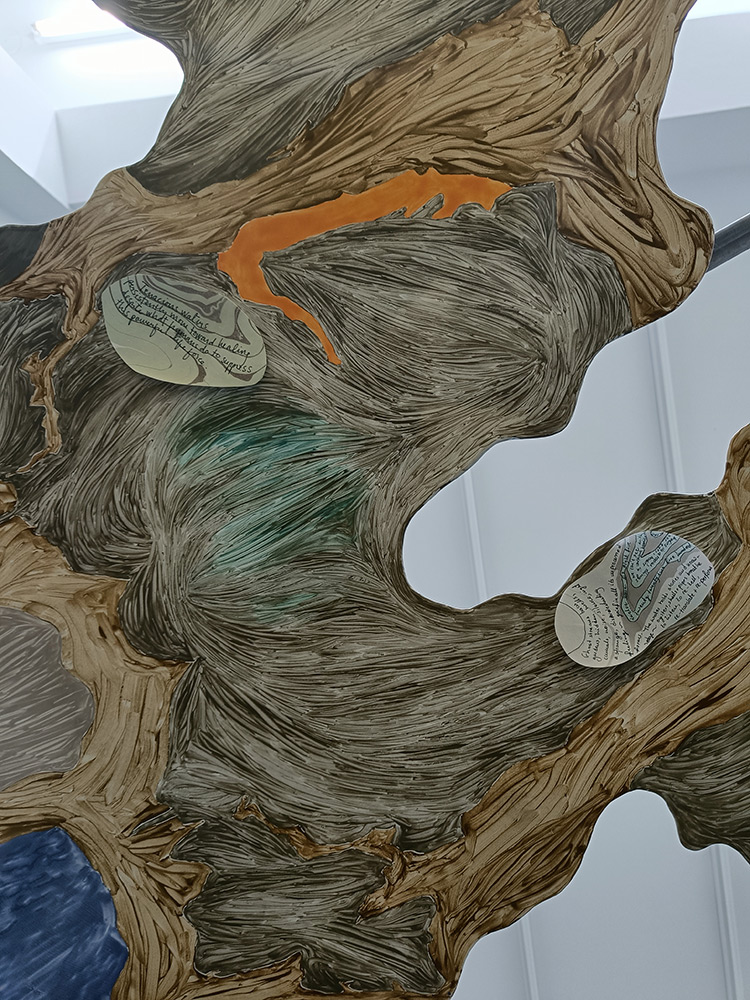
THE GRIEF SHRINE – Two Moons is designed as a container of the Climate thanatology project at SixtyEight Art Institute curated by Heidi Hart, an international laboratory for collaborative climate art developed in the U.S. and Scandinavia. The shrine is a passage for grief to let go of the world as we know it. A transitional space, a mini terraforming of earthly infrastructures; an embodied mapping of critical water zones: the Great Salt Lake in Utah, which is drying up, and Kalveboderne in Copenhagen, which is in risk of flooding. Vertically it is composed as a vault of floating silhouettes of the two water bodies, a two folded sky with two moons making ebb and flow one, connecting tides and temporalities. The Grief Shrine is both a painting and an installation: and in-between infrastructure.
The shrine is thought as an inspiration for future fluid and ephemeral constellations centered around questions like ownership, involvement, investment and anticipation imagining infrastructures as forms of growth that changes over time as controlled ruins compressing/stretching the inherent matter of time in the natural decay process in materials. The centerpoint being on the affordance and richness of ruins [3] opposed to seeing the land as a failed relic, and/or as unfinished objects [4] not only to be understood as open for appropriation in use and multi-functional, but also as the way they enter into relations with the surroundings, where the user or agent might not be human but a collective/assemblage/ecology of cultivating structures. As Superflex’s Infrastructures for Fish made for/with fish and other specimens. How interconnecting forces, potentials, rhythms and temporalities can take part in a reframing of the landscape topographically setting a stage for something yet to come. [5]
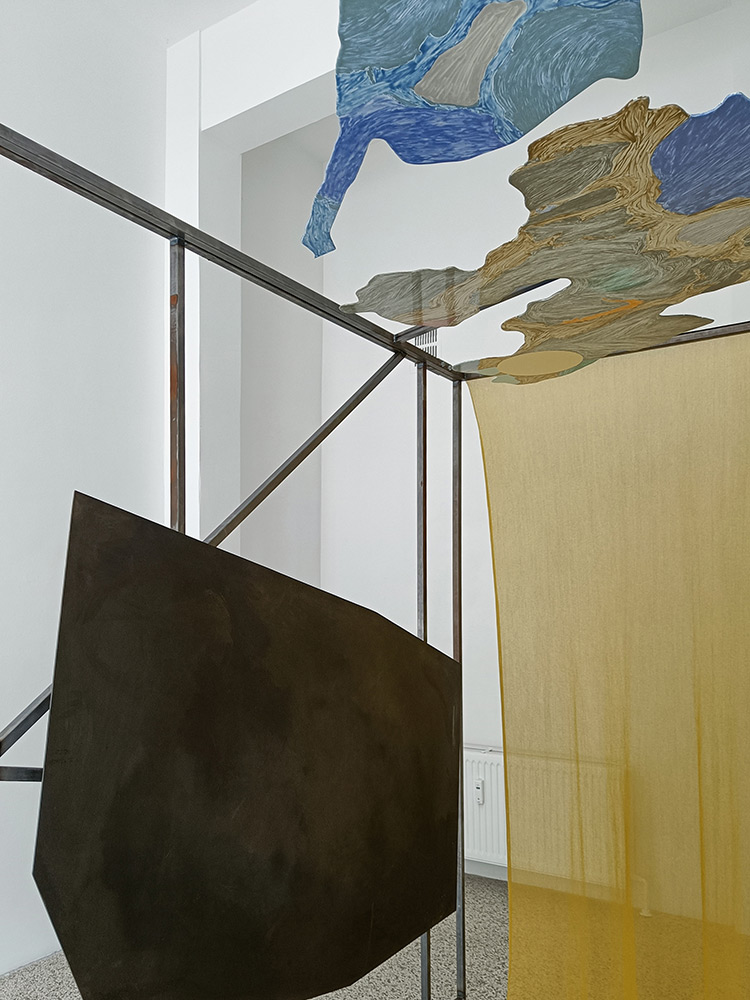
Anne Louise Blicher, Grief Shrine of Growth – Two Moons
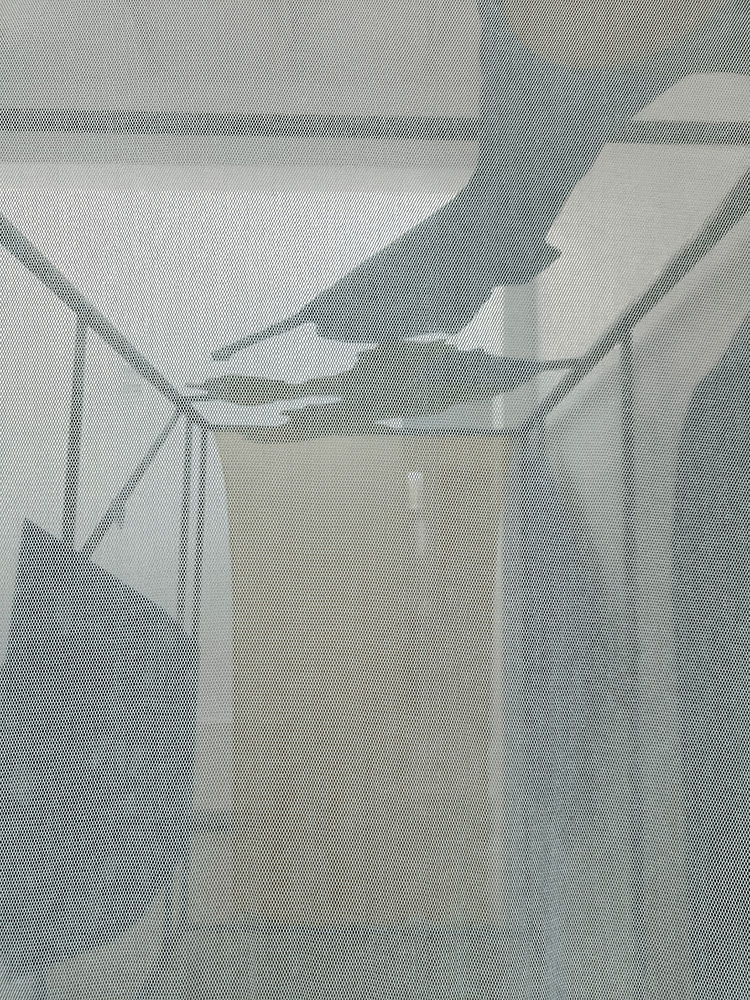
Anne Louise Blicher, Grief Shrine of Growth – Two Moons
The Grief Shrine’s materiality is composed of contrasting inherent timespans. Eel grass, a natural non-toxic C02 storing material which compost naturally, iron which rusts soon based on atmospheric factors like humidity and sunlight, and enamel, which does not rust, is very durable, resistant to chemical attack, graffiti, UV light, and is tactile safe, as it does not absorb bacteria or attracts dust. As well as tulle used in a more symbolic way with reference to the Victorian mourning shawl tradition to give physical space for grief, protect against negative thoughts and inspire positive thinking. Originally dyed black to create distance but in the shrine used as colored curtains to frame a togethering. Inspiration is drawn from the Mexican aromatic mourning shawl ‘rebozo de luto’ as well, which has scent impregnated in its fibers; smokes of herbs like rosemary, moss woven into the garment, threads soaked in lily water or cacao juice, connecting memory and scent, life and death. In the shrine the eel gras adds in a similar way a mild odeur of salted hay to the installation.
Inspired by Freuds idea of removing the desire of something lost by reinventing it in something else the Climate Thanatology laboratory for collaborative climate art translates sorrow into other forms of energy, which is synthesized in the shrine using sound and writing. Music-thanatologist Catherin Delong playing harp to help people encounter the dying process as a natural passage, has here turned her practice into an eco-thanatology playing harp for the quickly disappearing Great Salt Lake on site. Her sound piece has afterwards been remixed by UK music duo Silo Portem with sounds from an old ash three made into an acoustic instrument Resonant Bodies by artist Julia Adzuki as well as reindeer grunting and scraping, and calls from the lapwing. Inspired by the Japanese Ema shrine, in which Shinto worshippers write wishes for the future, hope, fear, memories, reflections about The Loss of the World As We Know It by participants in Death Cafés in Utah, New York and Copenhagen written on Suminagashi paper leaves made with water from each event location by artist Lana Neilson are planted into the shrine, which makes the shrine transform and grow over time.