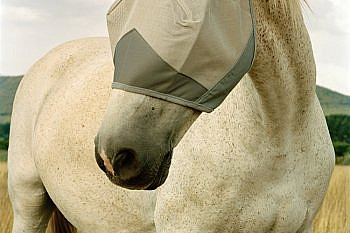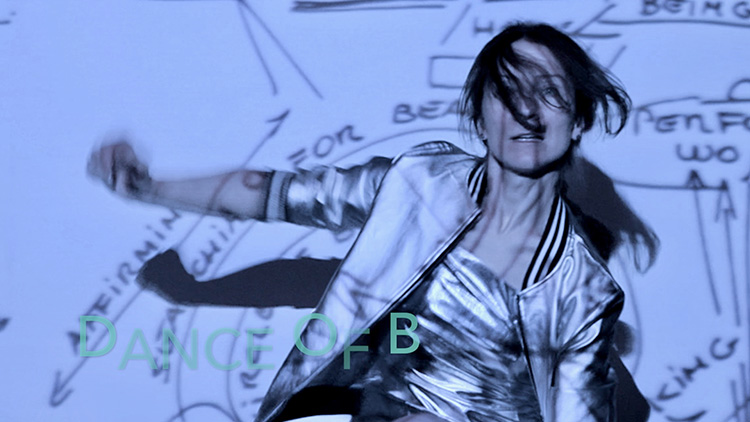
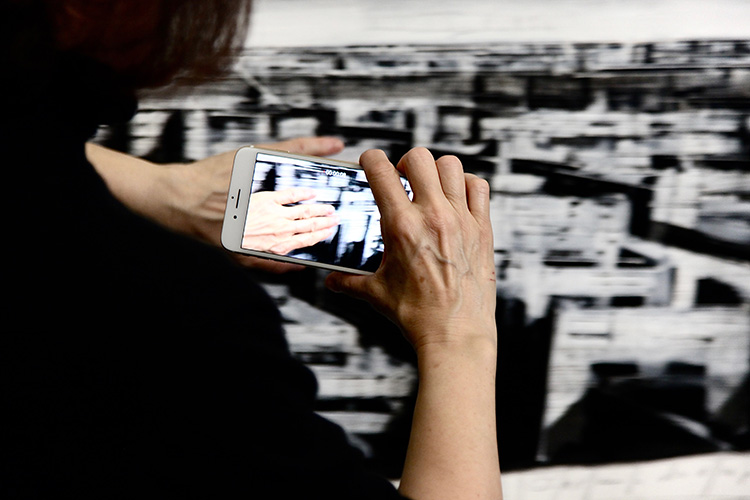
Still picture from Floating Heart-for Orlando, The Videobook. Sigita Mikalauskaitė performing Beauty
From the Latin corpus meaning “complex, organism,” the Italian word corpo is a generic term identifying any type of limited portion of matter capable of extension, divisibility, impenetrability. Both senses of this term, central to the conversation I had with Gianna Valenti, are present and fundamental. They presented themselves to us right from my first question and immediately in her first answer. What emerged in this conversation is a teaching proposal that finds our true nature in the movement and expression of the body, so that each of us, in our uniqueness, reconnects not only with ourselves but with everyone and everything around us. The message that Gianna Valenti advocates is one of individual responsibility that extends to collective responsibility.
Gianna Valenti is an artist and author working with pedagogy, choreography, dramaturgy, theatre and writing. After embodying different modern and contemporary dance techniques and graduating at the Milan State University, she completed a Master of Arts in Dance Studies at University of California Riverside where she graduated with Susan Leigh Foster who tutored her in the theory and analysis of choreographic processes and in improvisation and where she worked with Heidi Gilpin. In the 90’s, she worked in Lithuania as a choreographer and pedagogue and was then selected as a EC artist to study in Amsterdam with Marianne Van Kerkhoven and Hans-Thies Lehmann. After studying acting in the Strasberg and Stella Adler tradition, she started teaching and researching the principles of performance practice working on the interactions of physical and textual actions. She currently coaches for choreography and dramaturgy, in full support of individual creative processes, with a focus on the embodiment of thinking and the intelligence of the physical body. As an author she writes about dance and performance, choreographic codes and dance practices.
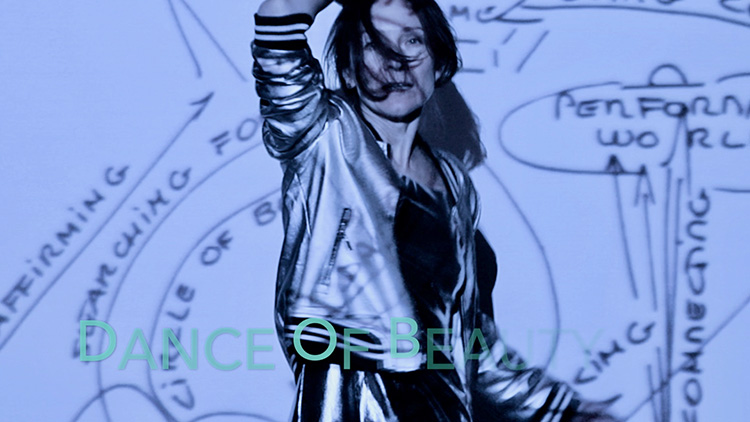
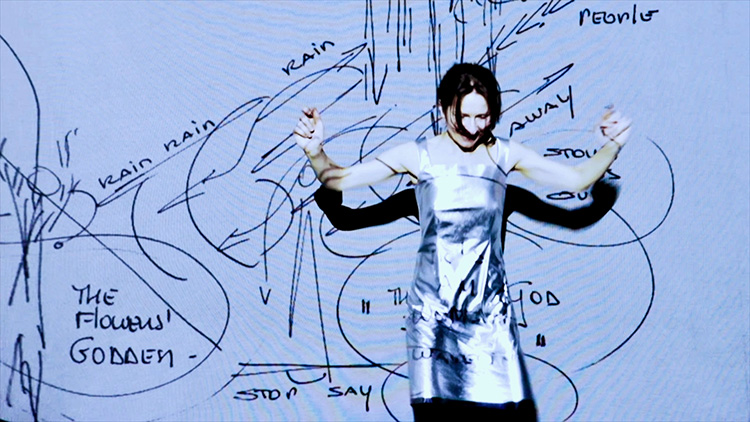
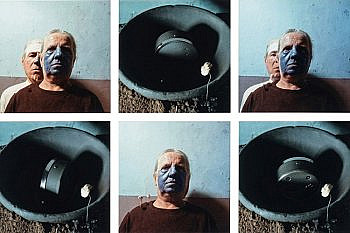
Still picture from Floating Heart – for Orlando, The Videobook. Sigita Mikalauskaitė performing Beauty
Chiara Causo: Starting from the origins, before performance, dance, and theater, what drove you to approach life with the body?
Gianna Valenti: Even in my very early childhood, I felt the need to know and relate to the world with my body. Spoken language wasn’t my priority, it was tiring for me. In our early years of life, we come into contact with our true nature, and it is our responsibility to be faithful to it beyond any technical learning and the subsequent inevitable contaminations. To be faithful by maintaining a vision that transcends details and keeps itself open to the body as a complex relational system.
Throughout my training and teaching time, I have committed to making the forms of the body and speech dialogue. In approaching the study of theater, I sought to include the actors’ mode of using language into my bodily awareness and worked to bring all understanding back into physicality. I fall in love with what I don’t know and the actors’ way was the unknown. I went there and an exchange was made possible: the language of the body expanded into other languages, rooting them in the body and always returning to it.
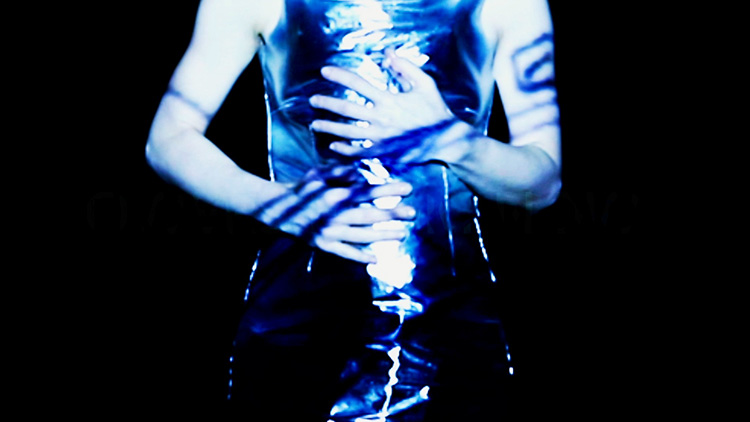
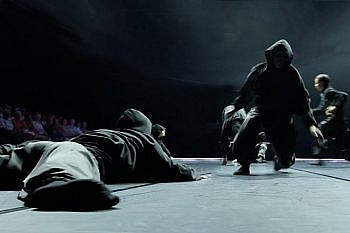
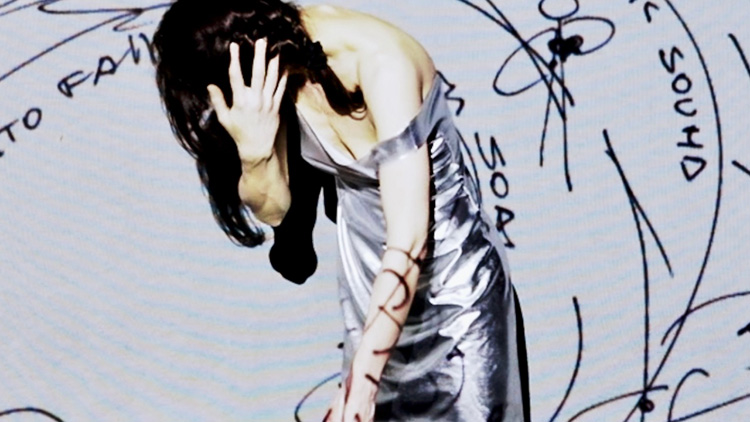
Still picture from Floating Heart – for Orlando, The Videobook. Sigita Mikalauskaitė performing Flowers
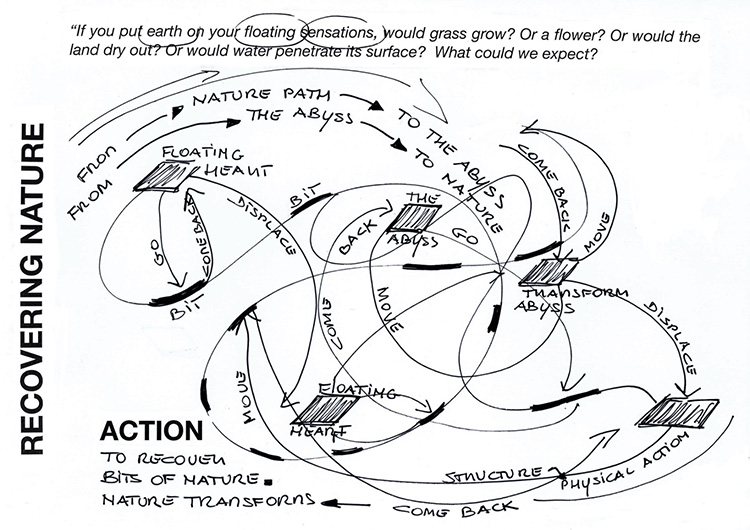
Gianna Valenti, drawing from Visual Dramaturgy for Floating Heart for Orlando
CC: Reflecting on this loyalty to our inner nature, do you think it is inevitable that the creativity of each of us will eventually emerge? In this regard, what did your time in America at the University of California with Susan Leigh Foster leave you?
GV: The ability to discover oneself in one’s creativity is an unstoppable wave, and it is inevitable. By following this impulse, after studying classical, modern and contemporary dance techniques, I chose the University of California Riverside to deepen my understanding about dance. America taught me the necessity of a practice oriented theory and of a practice always capable of describing itself, reflecting on itself and turning into a theoretical understanding. Susan Leigh Foster is the mother of this approach and one of the founders of Dance Studies and her second most important teaching was a choreographic system that values every individual danced action within an improvised performance as an action holding a collective responsibility. She also taught me the necessity to verbalize choreographic improvisation and to recognize and read the choreographic codes of the past and of the present, not only for a historical interest in a dialogue with the past, but as a nourishment for our practice in the present. Many of these tools belong to the philosophy of American postmodern dance, tools that still play a role in my work, the guiding principle being that we, in our embodiment, are inseparable from the space within and around us and from all other bodies inhabiting it.
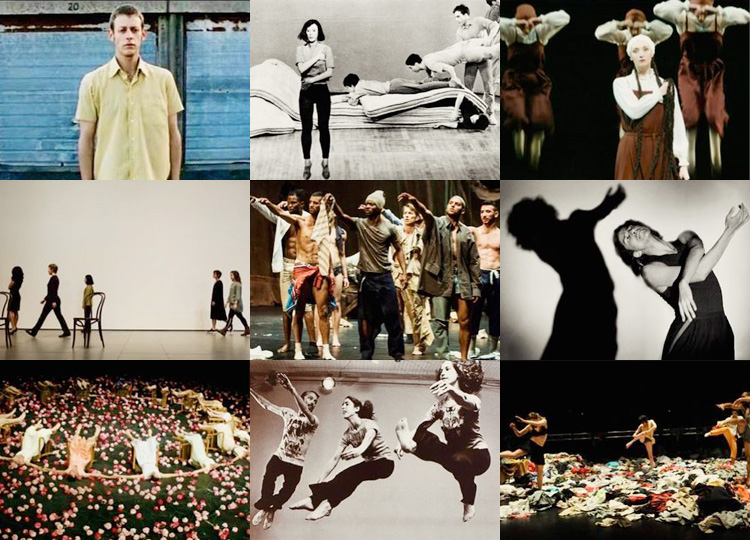
Gianna Valenti researches and writes about choreographic codes and the performing body
Still picture from the Videobook for Floating Heart – for Orlando, performance project for a solo performer, 2021
CC: You mentioned, when passing through the Physics Department on your way to class during your studies at the University of California, you would stop to observe the Foucault pendulum and how it made you think of a sense of collective body and how it was a space of reflection for you.
GV: In my work, over time, a possibility of the body as space has emerged, a body that knows how to take action at different levels simultaneously and that knows how to make use of the information circulating in a multiplicity of different directions. Observing the pendulum’s movement was a moment where I could think of the body as a presence that expands, dilates, enters into communication to generate actions and movements, being space and in dialogue with space. I think that the body in its physical language has a depth of presence that we have not yet opened our eyes to.
CC: Regarding theater, had you already envisioned an exchange of techniques and actions between dance and theater?
GV: My first encounter with actors was during my teaching time at the Vilnius Academy in Lithuania, during which I wondered what happens to a body when it is asked to act in stillness. To understand this, I studied Strasberg technique and then Stella Adler. I also acted on stage for a few years, which gave me a language of actions that I later applied to my pedagogical research on dance, movement, and choreography.
In teaching actors I looked for a path towards the organic nature of the word, making their bodies enter spatial paths and physical actions in which they would encounter words not as thought actions, but directly and purely as acted out presences. A different process from the one I had undergone in learning acting, but somehow easier, as impulses, actions, thoughts, and emotions are embodied and you just need to know how to activate and trust your physical body in a given spatial organization to release them. I had used my choreographic knowledge to work on texts and the exchange had occurred.
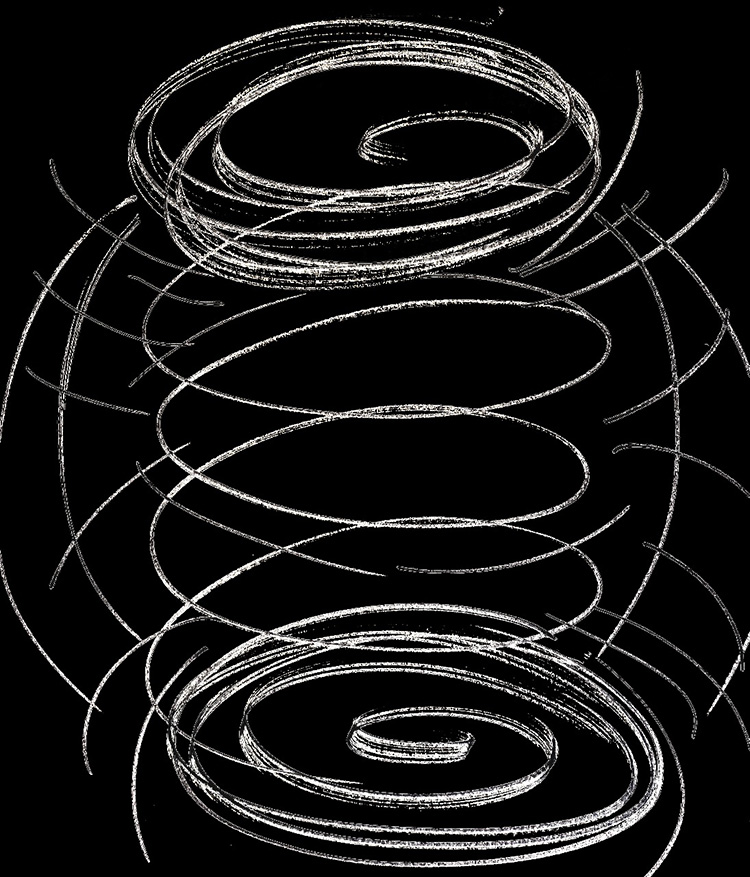
Figure 1 Gianna Valenti Human Body Field
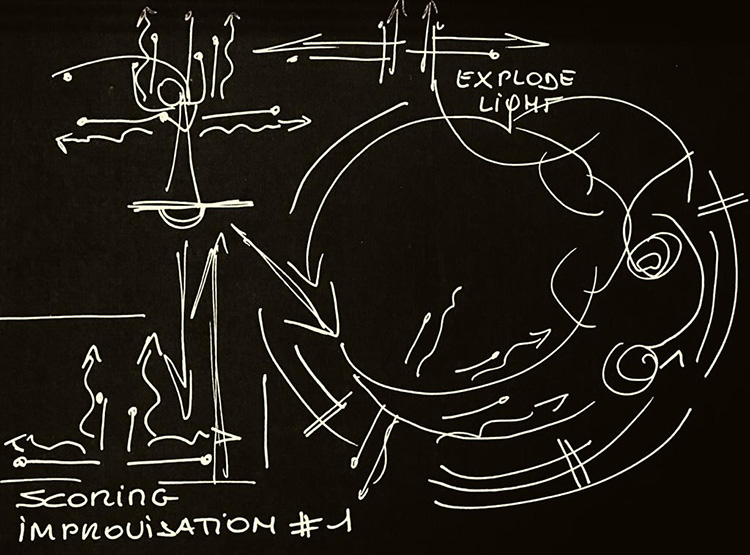
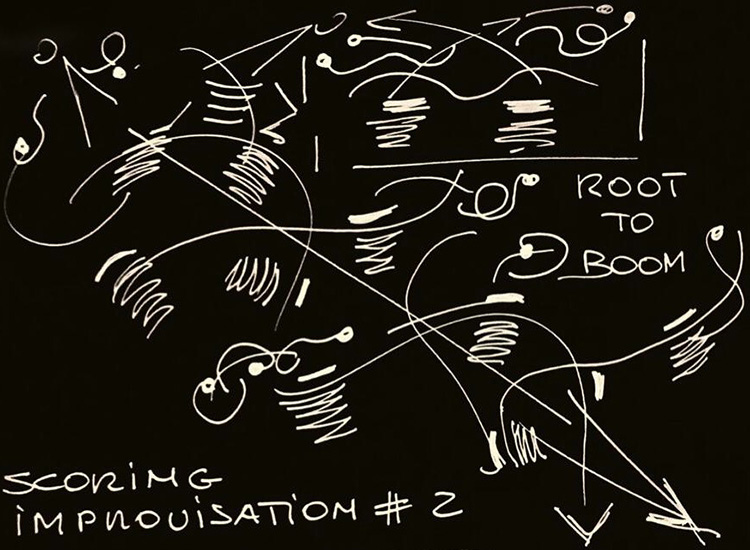
Gianna Valenti, Scoring Improvisation drawings
CC: What emerges from this conversation and your teaching approach is the desire to help the student’s nature emerge. What have been the results of this exchange and approach?
GV: Awareness and creative autonomy are the main objectives of my teaching in choreography, physical thinking or dramaturgical practices. The awakening of creativity and the responsibility of each individual in respecting their nature and talent are among my top priorities. I always wanted, from the very beginning, to move away from teaching as an imitation system.
CC: In light of this desire to give voice to talent, do you think it is really possible for each of us to have an actual impact on the collective?
GV: We will discover that every individual is essential in the capacity to have an impact on the collective, which must be made up of strong identities and individualities. Significant impact can only be achieved when one discovers their mission, which is of course different for each of us. We must be aware of our responsibility to our uniqueness, accept and include others, bowing to their diversity, thus becoming individual incarnations of a collective self.