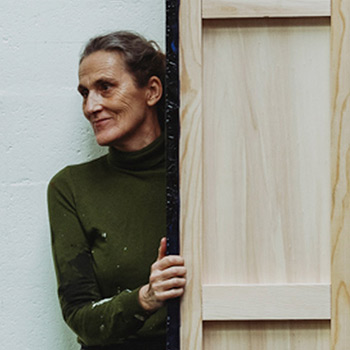
Julie Hascoët is a young visual artist born in France. She graduated from l’Ecole Nationale Superieure de la Photographie (ENSP – Arles) in 2012 after studying Visual Arts. Her work questions the notions of territory, architecture, entropy, and she extends the practice of photography to a more general research on installation, printed matter and self-publishing. Her work has been shown on photo & publishing-related festivals (La Gacilly Photo Festival, Les Rencontres d’Arles, Tbilisi Book Days, etc.), in solo shows, web and printed publications. She is member of Hans Lucas photo agency. Besides her artistic practice, she is also founder of Zines of the Zone, a traveling collection of self-published zines & books photo-related.
Her main project Murs de l’Atlantique is a photographic installation which draws a panorama of the Breton territory and suggests a visual dialogue between two specific phenomena: 1. The remains of the Atlantic Wall (blockhaus, bunkers) that mark the landscape in a heavy and permanent way / 2. The ‘free parties’ which act like Temporary Autonomous Zones (TAZ), appearing spontaneously to disappear immediately, and invite techno music lovers to gather each weekend for a party in a place kept secret until the last moment. These are two ways of occupying the same territory. Two phenomena with apparently nothing in common, but yet deal with the same notions of architecture (one permanent, the other, nomadic and spontaneous), closure (walls of concrete, walls of sound), of cartography and resistance. This is a work that questions how to occupy a space and that offers, at the same time, a poetic walk in the isolated, interstitial and open areas that shape the Breton landscape.
Julie Hascoet





-
untame flow stay releaseAug 31 – Nov 29, 2026untame flow stay release presents artistic practices undertaken in response to unjust, environmentally toxic and ableist structures – systems that continue to suppress individuals and communities by individualizing violence...
-
Ryuichi SakamotoComposer / MusicianIf Ryuichi Sakamoto had been born in 16th century Italy, we’d know what to call him: a Renaissance Man. But since he was born in Japan in the mid-20th century, we have to string together words like composer, musician, producer, actor, and environmental activist.
-
Lars TunbjörkPhotographerWhether creating an acid portrait of Sweden, representing the nightmarish world of business offices, tapping into the desolate uniformity of petrified, petit-bourgeois neighborhoods, Lars Tunbjörk has totally forgotten his black and white beginnings.
-
Visionary LandscapesOct 1 – Dec 16, 2026Swedenborg House is pleased to announce Visionary Landscapes, an exhibition exploring the relationship between landscape, imagination and visionary states. Curated by Museum Director Stephen McNeilly, the exhibition brings together historic works in dialogue...
-
Marc LagrangePhotographerMarc Lagrange (1957–2015) was born in Kinshasa, Congo. His career path led him from engineering to photography, and his creativity from fashion to art. Privileging analog over digital, the Antwerp-based Belgian artist searched for intimacy and emotion as opposed to artificial effects.
-
Forever Marked By The DayJun 26, 2026 – Jan 3, 2027Reflecting on loss, resilience and the power of rebuilding, “Forever Marked By The Day: A Quarter Century of Mourning and Renewal” marks 25 years since the attacks on Sept. 11, 2001. Approached through an architectural lens, the exhibition fosters intergenerational dialogue...
-
Our 9th Year AnniversaryArtpil / Prescription 176Here we are again, this time, rounding out our ninth year with 7,000 pages of Articles, Profiles, and Announcements in our growing archive and over 10 million visits strong. A very exciting journey it has been ...
-
The Present as FoundOctober 2–23, 2026The divergent creative practices of this year’s Zvono Award finalists – Ljiljana Arsić, Isidora Branković, Mustafa Mlinarević, and Emina Veladžić – have shaped a media-heterogeneous, methodologically diverse, and conceptually multilayered exhibition.
-
Marc Chagall: The CircusNov 21, 2026 – Apr 25, 2027
Throughout his prolific career, Marc Chagall (1887–1985) returned time and again to the vivid imagery of acrobats, clowns and fantastical performers. Marc Chagall: The Circus will present Chagall’s celebrated lithographs on this subject…
-
Making Futures 2026: International Research ConferenceOctober 29–31, 2026For its 2026 international conference, Making Futures (TM) will explore the relationship between objects, material intelligence and the emotional encounters we design with and through the natural world around us.
-
Iris van Herpen: Sculpting the SensesMay 16 – Dec 6, 2026
Van Herpen transcends conventional clothing norms while embracing both traditional couture artisanship and innovative techniques. Ranging from the micro to the macro, the exhibition explores the body’s place in space…
-
Ahn Chang-Hong: noon-moolSep 5 – Dec 6, 2026American University Museum is honored to present noon-mool, a major solo exhibition by Korean artist Ahn Chang-Hong. Occupying both the second and third floors of the museum, the exhibition offers a rare opportunity...
-
Extreme PresenceOctober 23–25, 2026What forms does presence take when the world and its technologies exceed what can be explained, known, or felt? How to re-imagine human, non-human and synthetic life on this planet today?
-
Wolf TonesOct 3, 2026 – Apr 4, 2027
Wolf Tones presents the work of six artists as a refracted analogy of an acoustic phenomenon. The wolf tone is an irregular vibration produced by a musical instrument such as the cello. It is the result of an acoustic conflict produced by its wooden body.
-
The Other Side of the MountainOct 14, 2026 – Mar 21, 2027
The Other side of the Mountain brings together contemporary artists working across the African continent and within the Afro-Nordic diaspora. They explore how cities and modern landscapes shape our connections to one another…
-
40th Anniversary Archival PresentationMar 19 – Dec 20, 2026The MIT List Visual Arts Center traces its origins to the Hayden Gallery (founded in 1950), which brought artists and the MIT community together through diverse exhibitions and residency projects.
-
Irène ZurkindenAug 27 – Nov 28, 2026Coinciding with Kunsttage Basel, this August we present a solo exhibition dedicated to the work of Swiss artist Irène Zurkinden (1909–1987) at our Basel gallery. Zurkinden defied easy categorisation, developing a distinctive painterly language...
-
Relic 4: Larry AchiampongOct 16 – Dec 12, 2026This autumn, Larry Achiampong will present his new film Relic 4 (2026) at KARST, revisiting the cinematic universe of the Relic Traveller project after a six-year hiatus. Exploring themes of fallen empire, class, and displacement...
Visit our New Announcement Submission page > Announcement Submission page >